
Tracked vs Wheeled Conveyor: Which Should You Choose?
- Updated 2026-11-10
- Source:

A tracked conveyor often suits frequent, short moves around a changing production area. A wheeled conveyor can suit prepared stockyards where the travel arrangement and available towing equipment match the workflow. Choose between them by checking the ground, movement frequency, transport requirements and conveying duty together.
The tracked vs wheeled conveyor decision involves more than traction. A machine that moves easily around a crusher may need different arrangements for radial stacking or transport to another quarry. Likewise, wheels alone do not establish road-towing suitability.
This guide compares bulk-material belt conveyors and stackers within the wider range of mobile conveying equipment. It uses published model specifications and practical selection criteria to explain which configuration deserves a place on your shortlist.
What Is the Difference Between Tracked and Wheeled Conveyor?
A tracked conveyor travels on crawler tracks, while a wheeled conveyor uses tyres and axles for support and movement. The main difference concerns mobility; both configurations can carry bulk material on a belt.
On a self-propelled tracked machine, the operator uses the travel drive to reposition the conveyor. A wheeled machine may require a towing vehicle or offer powered travel, depending on its design.
The table below details the differences between tracked-mounted conveyor and wheeled-mounted conveyor:
| Selection factor | Tracked conveyor | Wheeled conveyor |
|---|---|---|
| On-site movement | Self-propelled tracks support repositioning within the machine’s travel limits. | Towed or powered movement depends on the axle and drive arrangement. |
| Ground assessment | Check track contact loads, traction, slopes and turning conditions. | Check wheel loads, tyre specification, rutting risk and support points. |
| Relocation workflow | Evaluate travel controls, clearance and feed-point realignment. | Evaluate towing access, steering and any axle-position changes. |
| Off-site transport | Check folded dimensions, weight and trailer loading requirements. | Confirm whether the design requires a trailer or supports approved road towing. |
| Chassis maintenance | Inspect tracks, rollers, sprockets, tension and travel drives. | Inspect tyres, hubs, bearings, axles and any fitted steering or braking systems. |
Start with the movement pattern, then compare individual models. The chassis category alone cannot establish capacity, stability or total operating cost.
Which Conveyor Suits Your Ground Conditions?
Ground suitability depends on the machine’s loads, contact arrangement and the site’s bearing capacity. Crawler may help on uneven or loose surfaces, while wheels can suit firm, prepared routes.
Tracks distribute load through their ground-contact area. However, machine weight, track dimensions and load distribution determine the actual contact pressure. A heavier tracked machine does not automatically exert less pressure than every wheeled alternative.
For a wheeled conveyor, check tyre loading and the condition of the complete travel route. A compacted yard may provide suitable access during dry weather but develop ruts after heavy rain. Evaluate drainage, loose fill and transitions between concrete and unpaved ground.
Assess travel and operation separately. Some configurations transfer load onto supports during stacking, so the ground beneath those supports matters as much as the route used to reach them. Ask the supplier for operating support reactions, travel limits and the required setup conditions.
On paved sites, discuss track type and turning movements. Steel tracks and tight turns can damage some surfaces. Compare those concerns with tyre loads and the turning space a wheeled unit requires.
Use the SANTO tracked conveyor specifications as a starting point, then confirm the proposed machine’s ground and support requirements against your site assessment.
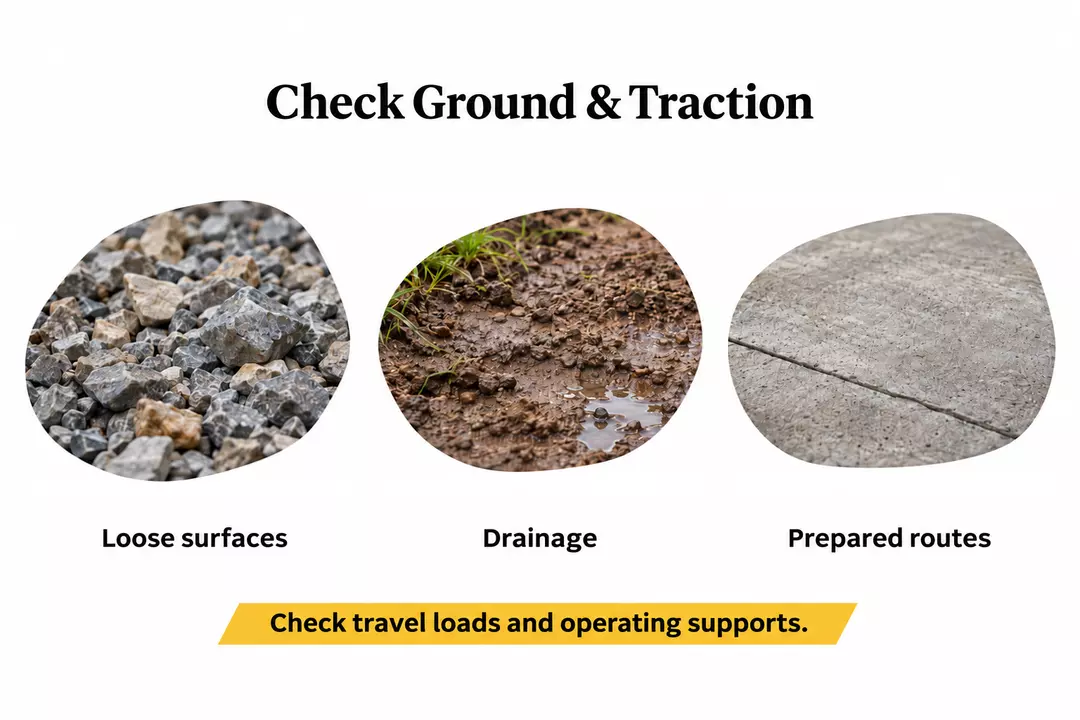
Ground surfaces and traction checks for selecting a tracked or wheeled conveyor
Which Is Better for Frequent Repositioning?
A tracked conveyor often suits frequent, short repositioning around mobile processing equipment. A wheeled conveyor can also work well when prepared routes, powered travel or readily available towing equipment support those moves.
Consider a conveyor that follows a mobile crusher. The operator must maintain feed alignment as the production area changes. Independent travel can reduce coordination with a separate towing vehicle, but it does not eliminate the time needed to clear the belt, manage connections and restart production.
SANTO tracked stacker series are suitable for receiving material from crushers, screeners and grinders, with tracks supporting on-site movement.
Record the following before comparing types:
- How many moves the conveyor makes during a typical shift.
- The distance and route for each move.
- The people and support equipment each relocation needs.
- The time between stopping feed and restarting steady production.
Does a Tracked or Wheeled Chassis Change Conveyor Capacity?
The chassis does not determine throughput on its own. Belt width, speed, loading profile, inclination, drive power and bulk-material properties determine the conveying duty the machine can handle.
SANTO’s published specifications provide a useful comparison. The TS1020 tracked stacker and WS1020 wheeled stacker both list a 1,000 mm belt width, a 20 m length and a 500 t/h capacity, despite their different chassis and weights.
| Published specification | SANTO TS1020 | SANTO WS1020 |
|---|---|---|
| Chassis | Tracked | Wheeled |
| Belt width | 1,000 mm | 1,000 mm |
| Length | 20 m | 20 m |
| Capacity | 500 t/h | 500 t/h |
| Stacking height | 8.6 m | 8.7 m |
| Weight | 11.5 t | 6.1 t |
The comparison shows that different chassis can serve the same published throughput duty. It does not establish equal performance for every feed condition or prove that the lighter machine costs less to operate.
Provide the supplier with bulk density, maximum lump size, moisture and normal and peak feed rates. Also specify the required discharge height. If one quotation uses tonnes per hour and another uses cubic metres per hour, agree on the bulk density before comparing them.
Can Both Types Provide Radial Stacking?
Yes. Both tracked and wheeled stackers can provide radial stacking when the machine includes the appropriate pivot, travel or slewing mechanism.
Keep three functions separate. Site travel moves between operating positions. Radial movement sweeps the discharge through an arc. Telescopic extension changes the conveyor’s reach. A machine may combine these functions, but each requires its own mechanical arrangement and controls.
Telestack’s TC Revolution provides a specific tracked example: a centrally mounted slew bearing enables 360° rotation. That capability belongs to the stated design; it does not apply automatically to other tracked conveyors.
Superior also distinguishes different axle arrangements for its TeleStacker. Its pit-portable option changes axle positions for transport and radial movement within the pit, and the manufacturer identifies that arrangement as non-road-portable.
Define the required stacking arc, feed-point location, discharge reach and available clearance before choosing the chassis. The radial stacker selection guide explains how these functions affect stockyard planning.
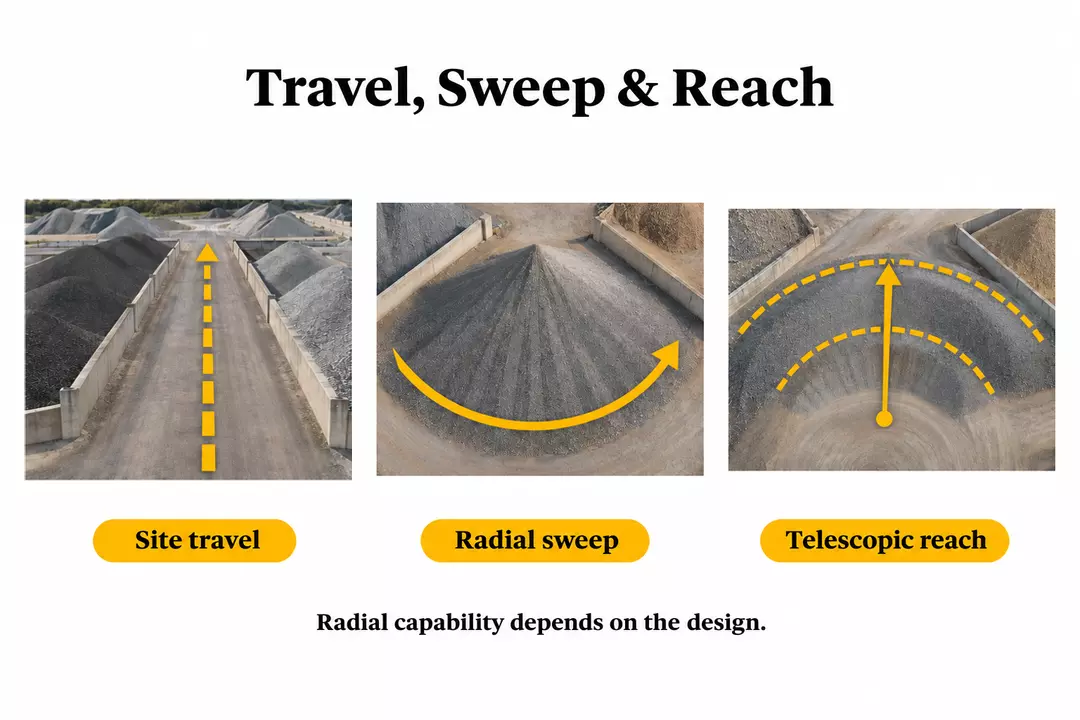
Comparison of stacker site travel, radial sweep and telescopic reach
Which Conveyor Has Lower Operating and Maintenance Costs?
The lower-cost conveyor is the one that meets your duty with the lowest total cost per tonne over the same assessment period. Compare purchase, relocation, energy, maintenance and downtime costs together.
A wheeled configuration may avoid some crawler-undercarriage components, but towing support and ground preparation can add costs. A tracked machine may simplify frequent repositioning, but its travel system still needs inspection, cleaning and replacement parts. Neither comparison establishes a universal winner.
What maintenance does each chassis need?
For tracks, follow the manufacturer’s procedures for tension, roller condition, sprocket wear, debris removal and travel-drive servicing. For wheels, check tyres, bearings, hubs and axles, plus steering and braking components where the configuration includes them.
Both designs also require attention to belt tracking, conveyor idlers, pulleys, cleaners, transfer points and guarding. Chassis selection does not remove those shared maintenance tasks.
How should you compare ownership costs?
Use a consistent calculation:
Cost per tonne = Total attributable cost during the assessment period ÷ Tonnes handled during the same period.
Include equipment ownership cost, delivery, site preparation, energy, labour, towing support, maintenance and expected downtime. Treat resale value consistently and avoid counting the purchase price and depreciation twice.
Ask suppliers to quote the same conveying duty and accessory scope. A lower headline price means little if the quotation omits the drive package, controls or transport equipment your operation requires.
Which Configuration Fits Your Application?
Match the chassis to the application’s movement pattern. A changing crusher location, a permanent stockyard and a contractor moving between sites can require different configurations even when they handle the same aggregate.
| Operating situation | Configuration to investigate | Deciding checks |
|---|---|---|
| Frequent short moves behind a mobile crusher | Self-propelled tracked conveyor | Travel route, feed alignment, ground conditions and complete relocation time. |
| Prepared yard with occasional relocation | Wheeled conveyor with a suitable travel arrangement | Towing availability, wheel loads, turning space and operating supports. |
| Repeated radial stacking around a feed point | Either chassis with a confirmed radial system | Sweep clearance, pivot arrangement, wheel paths or slew mechanism. |
| Frequent moves between projects | Either chassis with a suitable transport package | Folded dimensions, shipping weight, loading time and transport cost. |
| Changing recycling work areas | Compare both against the actual route and debris conditions | Ground protection, tyre or track exposure, feed variability and cleanup access. |
For quarry operations, start with crusher output, stockyard geometry and reclaim access. The wider aggregate handling arrangement for quarries and mines helps determine where mobility adds value.
For recycling, inspect the actual feed and travel routes. Requirements for construction waste conveying may include variable lump sizes, abrasive feed and debris around the equipment. Address those conditions alongside chassis choice.