
Rail Loading and Unloading Conveyor System | SANTO
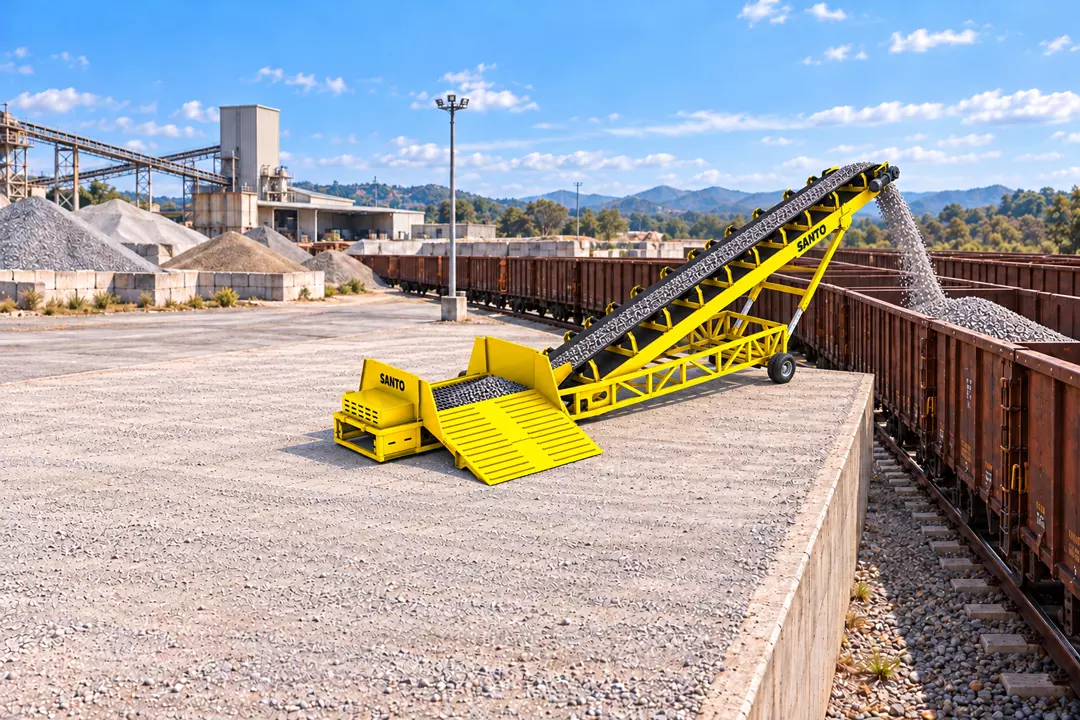
Move bulk materials between trucks, railcars and stockpiles with a conveyor arrangement that fits your rail operation. SANTO mobile conveyors and hopper feeders support material receiving, controlled feeding, transfer and stockpiling.
Start by identifying the direction of movement: truck to rail, rail to truck, or rail to stockpile. Then match the equipment to your wagon openings, material properties and available working space.
Explore SANTO’s mobile material handling equipment to identify the machines that can serve each stage. A rail loading conveyor and a rail unloading conveyor may share some transfer functions, but they need different receiving and discharge arrangements.
Configure Your Rail Loading Conveyor System
A rail loading conveyor system connects the material source with the wagon’s loading opening. The route should accommodate incoming deliveries, regulate flow and position the discharge point correctly.
Truck-to-Rail Loading
Tipping Truck → Truck Unloader → Loading Conveyor → Railcar
A truck unloader receives road-delivered material and feeds the loading route. Depending on the distance and geometry, the arrangement may use a direct discharge or an additional transfer conveyor.
The SANTO Radial Truck Unloader provides one receiving option. SANTO lists the RTU1215 with a 1,200 mm belt, 15 m conveyor length and 700 t/h capacity. These figures describe the receiving machine, not the complete rail loading operation.
Check truck access, tipping space, wagon opening dimensions and discharge reach before selecting the configuration.
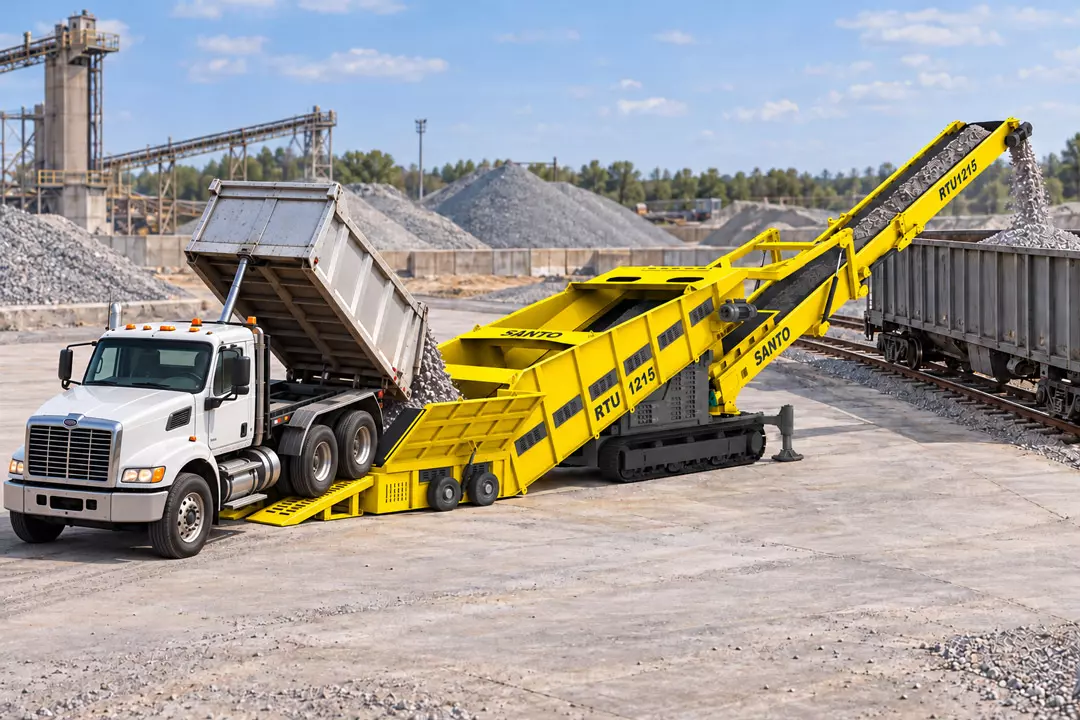
Truck reversing onto SANTO RTU1215 radial truck unloader for direct railcar loading
Loader-Fed Rail Loading
Wheel Loader → Hopper Feeder → Loading Conveyor → Railcar
A wheel loader collects material from a stockpile and feeds the hopper. The feeder regulates output to the downstream conveyor.
Match the hopper arrangement to the loader bucket, material and loading cycle. The loader still performs the initial feeding task; the conveyor can reduce subsequent carrying and transfer work.
Industry rail-loading applications commonly combine truck unloaders or loader-fed hoppers with conveyors to connect the material source directly to wagons.
Loading from an Existing Conveyor Line
Plant Conveyor → Transfer Conveyor → Rail Loading Point
An existing production line can supply the rail loading route when capacities and equipment interfaces match.
Provide the upstream conveyor’s discharge height, flow rate and material specification. The loading arrangement must also accommodate wagon positioning and the required distribution of material inside each car.
Match Rail Unloading to the Wagon Discharge Method
The wagon determines how material leaves the railcar. Select the receiving equipment around that discharge method before choosing the downstream conveyor.
Receiving Material from Bottom-Discharge Wagons
Bottom-Discharge Wagon → Compatible Receiving Unit → Transfer Conveyor → Destination
Bottom-discharge wagons release material through outlets beneath the car. The receiving arrangement must fit the outlet position, gate movement and available clearance.
Some terminals use an existing unloading pit. Others use a purpose-built low-profile receiving conveyor. Gruber’s portable transloader documentation, for example, identifies a low-profile pan section specifically for positioning beneath railcars.
Do not assume that any low-level hopper will fit beneath a wagon. Check the actual dimensions and approach route.
Receiving Grab-Unloaded Material from Open-Top Wagons
Grab or Material Handler → Receiving Hopper → Conveyor → Truck or Stockpile
A grab or material handler removes cargo from the wagon and places it into a receiving hopper. The feeder then controls flow onto the conveyor.
The SANTO Low Feeder Track Stacker accepts material from equipment such as grab cranes, excavators and wheel loaders. Its published range includes conveyor lengths up to 24 m and hopper capacities up to 8 m³.
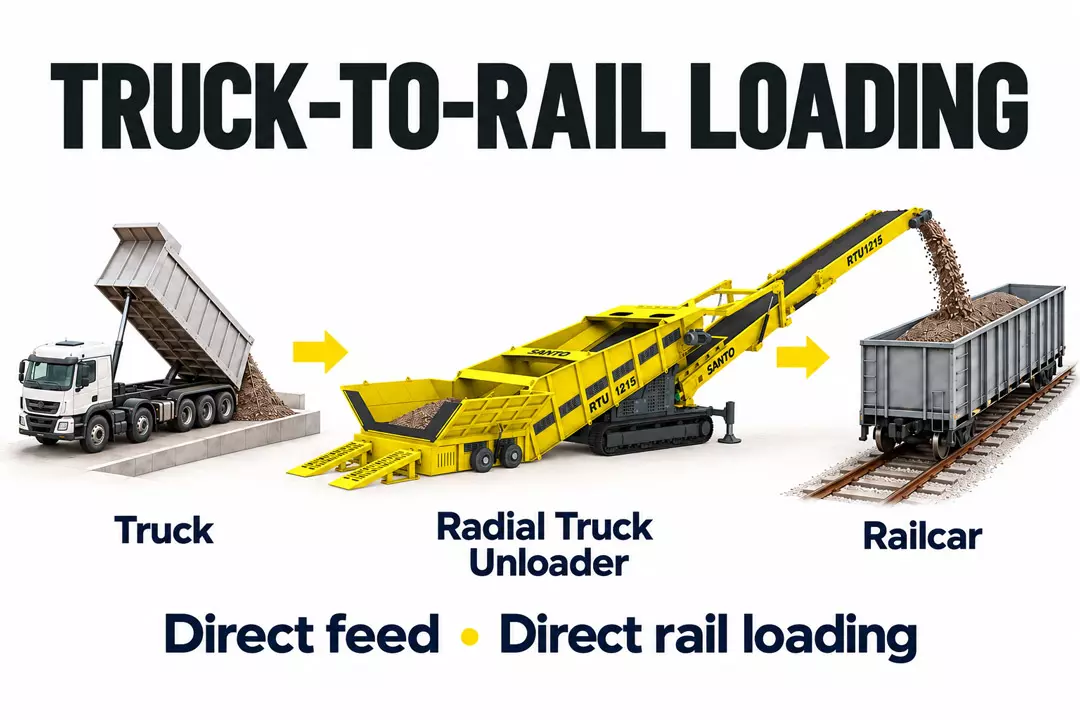
Truck-to-rail loading process using one SANTO RTU1215 radial truck unloader
Plan the Rail Transloading Route
A rail transloader moves bulk material between railcars and another transport mode, commonly trucks. The loading direction determines the receiving height, discharge position and equipment arrangement.
| Route | Main configuration priorities |
|---|---|
| Truck to rail | Truck receiving, controlled feed and reach to the wagon opening |
| Rail to truck | Wagon discharge interface, truck loading height and vehicle positioning |
| Rail to stockpile | Transfer distance, storage footprint and subsequent reclaim method |
Specialist transloader manufacturers configure equipment for different transfer directions rather than relying on one universal layout.
When the receiving point sits away from the loading or storage area, a SANTO Grasshopper Conveyor can connect the handling stages. SANTO lists length options from 20 to 45 m and adjustable discharge height.
Measure the route before selecting conveyor lengths. Inclination, transfer overlap and equipment positions determine usable horizontal reach.
Select Equipment for Receiving, Transfer and Stockpiling
Each machine should perform a defined task within the route. Match the receiving stage to the incoming material, then check the transfer and discharge stages against the same operating requirement.
Control Incoming Material with Hopper Feeders
Hopper feeders accept material in batches and regulate output. Choose the receiving geometry around the feeding equipment and the material’s flow characteristics.
The following SANTO model examples provide a starting point for comparison:
| Model | Equipment | Belt width | Length | Discharge height | Listed capacity |
|---|---|---|---|---|---|
| FTS1015 | Feeder Track Stacker | 1,000 mm | 15 m | 7.0 m | 500 t/h |
| RTU1215 | Radial Truck Unloader | 1,200 mm | 15 m | 7.1 m | 700 t/h |
| LTS1020 | Low Feeder Track Stacker | 1,000 mm | 20 m | 8.3 m | 500 t/h |
Use these published figures for preliminary selection. Confirm the material, operating geometry and connected equipment before applying a model rating to the project.
Connect Loading Positions with Mobile Conveyors
Mobile conveyors can link receiving equipment with a loading point or storage area. Check belt capacity, receiving height and discharge position at every connection.
For railcar loading, assess the wagon’s opening dimensions and required reach. Conveyor length alone does not establish whether the discharge can reach the intended position.
Build Buffer Stockpiles Beside the Transfer Route
A buffer stockpile can separate rail schedules from truck deliveries or downstream demand. The SANTO Tracked Radial Stacker provides a stockpiling option where the layout supports radial movement.
Plan storage capacity, product separation and reclaim access together. Adding a stockpile also adds a reclaim task, so compare that arrangement with direct transfer.
Estimate Throughput from the Full Railcar Cycle
A conveyor’s nominal capacity does not equal the average handling rate across a complete railcar cycle. Positioning, setup, material flow and changeover all affect the result.
Consider this illustrative planning example, using metric tonnes:
| Input or calculation | Example |
|---|---|
| Material quantity per cycle | 60 tonnes |
| Sustained conveying rate | 300 t/h |
| Pure conveying time: 60 ÷ 300 × 60 | 12 minutes |
| Assumed additional positioning and changeover time | 3 minutes |
| Total example cycle time | 15 minutes |
| Cycle-average throughput: 60 ÷ 15 × 60 | 240 t/h |
The 60 ton quantity does not represent a universal railcar payload. The 3 minute allowance is a calculation assumption, not a recommended operating time or a measured SANTO result.
Replace both values with your wagon data and operating records. Include any additional tasks that your loading or unloading process requires.
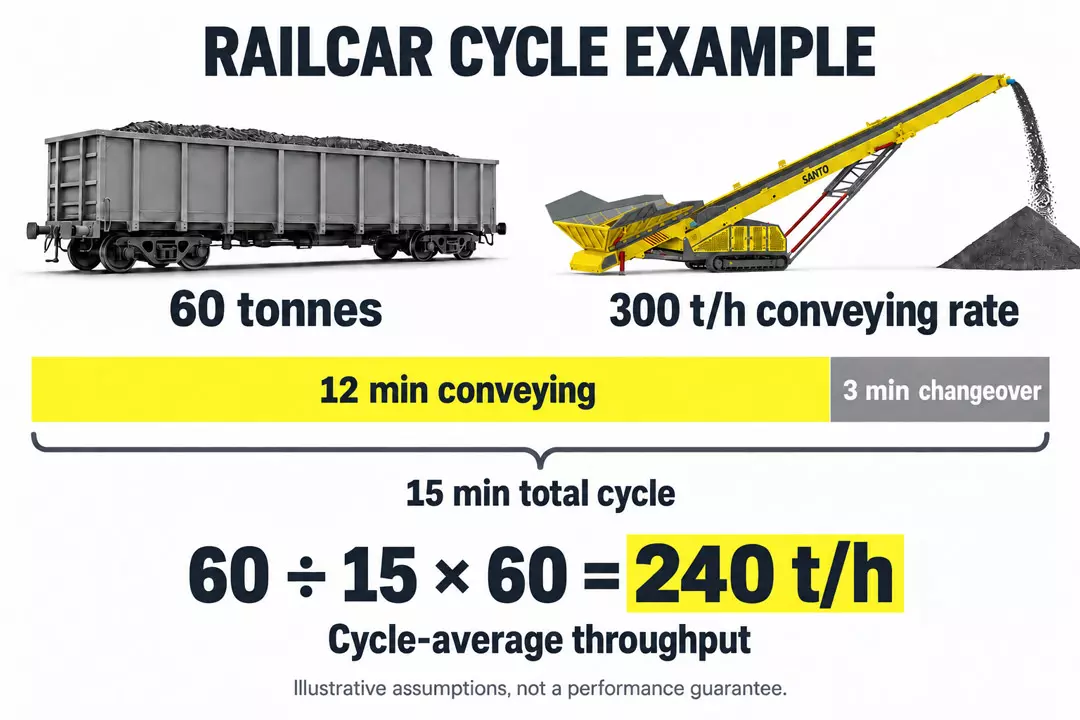
Rail loading conveyor cycle example: 240 t/h average throughput
Specify the Railcar, Material and Site Interfaces
Prepare the following information before requesting an equipment proposal:
| Project information | Details to provide |
|---|---|
| Operation | Loading, unloading or transloading direction |
| Railcar geometry | Wagon drawings, openings, outlet positions and gate movement |
| Equipment clearances | Receiving clearance, discharge height and required reach |
| Material properties | Bulk density in t/m³, maximum particle size in mm, moisture and flow behaviour |
| Operating target | Tonnes per car, required t/h and available handling time |
| Trackside layout | Working space, adjacent tracks, obstacles and access routes |
| Connected equipment | Existing feeders, receiving units, conveyors and destination details |
| Site services | Power supply, dust-control requirements, cleaning and maintenance access |
For loader-fed configurations, compare the receiving requirements with the SANTO Hopper Track Stacker range.
State the material’s condition as well as its name. Wet fines, large lumps and free-flowing granules can create different receiving and transfer requirements.
Rail unloading methods also vary substantially between sites. Astec’s rail-handling overview distinguishes bottom discharge, side tipping and below-ground receiving arrangements, reinforcing the need to define the unloading method first.
Include a dimensioned site sketch. It helps the equipment supplier evaluate the complete route rather than individual machines in isolation.
Rail Loading and Unloading FAQs
What is the difference between a rail loading conveyor and a rail unloading conveyor?
A rail loading conveyor carries material toward a wagon’s loading opening. A rail unloading conveyor receives material from a compatible unloading arrangement and carries it toward a truck, stockpile or processing line.
Can one conveyor system handle both loading and unloading?
Yes, transfer conveyors can handle both. But loading and unloading usually require different receiving and discharge arrangements.
Can a low-level hopper feeder fit beneath a railcar?
Only a dimensional assessment can confirm that fit. “Low-level” does not automatically mean the machine can enter the space beneath a railcar.
What determines the actual handling rate per railcar?
Material supply, wagon discharge behaviour, conveyor capacity and positioning time all influence the rate.
What information does SANTO need for a proposal?
Provide the material, operating direction, railcar drawings, target throughput and site layout. Include details of any existing receiving equipment or conveyors.
Discuss Your Rail Loading or Unloading Project
Tell SANTO where the material starts, where it needs to go and which railcars your operation handles. Share the target capacity, wagon dimensions and site layout so we can discuss receiving, transfer and stockpiling options.
Include:
- Loading, unloading or transloading direction
- Material properties and maximum particle size
- Railcar type and available drawings
- Required capacity in t/h
- Material quantity per car
- Existing receiving or feeding equipment
Contact SANTO to request a rail handling proposal.
External References