

Mobile Conveyor System for Cement Plant | SANTO
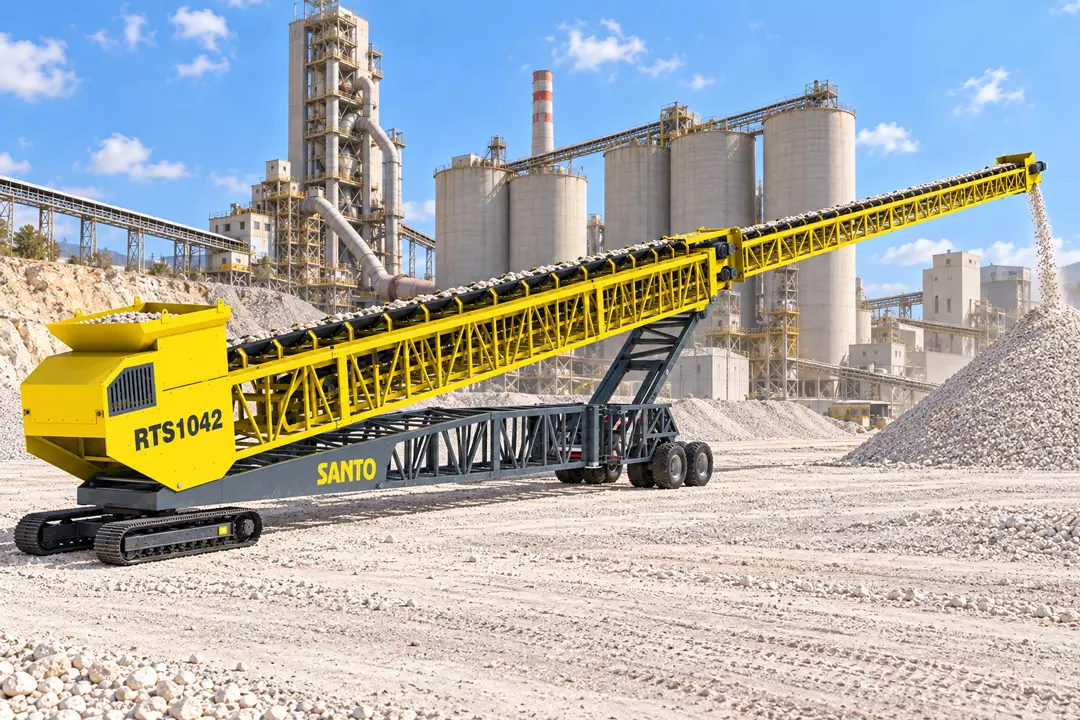
A cement plant conveyor moves bulk materials between receiving points, storage areas and processing equipment. SANTO mobile conveyors support truck unloading, hopper feeding, material transfer and stockpiling. Each configuration connects a specific material source with the next handling stage according to your plant layout and operating requirements.
Start with the material, the route and the required throughput. A limestone receiving area needs a different arrangement from a clinker transfer point or a finished cement powder line.
SANTO Machinery helps you select mobile equipment around these requirements, whether you need to feed an existing conveyor, organize raw material stockpiles or connect separate handling areas.
Match the Conveyor to Your Cement Plant Materials
Limestone, Gypsum and Granular Additives
Identify the material before choosing belt width, hopper geometry or conveyor length. Two materials can require the same throughput yet behave differently at the receiving hopper and discharge point.
For each material, provide its maximum lump size, bulk density, moisture content and operating temperature. These details help determine loading conditions, belt requirements and transfer arrangements.
| Material | Main handling considerations | Information to provide |
|---|---|---|
| Crushed limestone | Lump impact, abrasion and belt loading | Maximum particle size in mm and bulk density in t/m³ |
| Gypsum | Moisture, adhesion and material buildup | Moisture percentage and handling observations |
| Granular additives | Flow consistency and cross-contamination | Particle size range and storage requirements |
| Cooled clinker | Residual heat, abrasion and dust | Normal and peak temperatures in °C |
| Cement powder or raw meal | Dust containment and fine-powder behavior | Powder characteristics and enclosure requirements |
Use actual material samples or test results where possible. A material name alone does not describe how it will flow through your equipment.
Clinker Temperature and Fine Powder Requirements
Check clinker temperature at the proposed loading point, including peaks during process changes. The term “cooled clinker” does not establish a suitable belt temperature rating.
Hot or highly abrasive material may require dedicated conveying equipment. For example, AUMUND identifies pan conveyors as an option for hot and abrasive bulk materials. That illustrates why engineers must assess the conveying method before selecting a standard mobile belt conveyor.
Finished cement powder also requires a separate review. Powder containment, moisture protection and the receiving process influence the equipment choice. WAMGROUP describes dedicated screw conveyors and feeders for cement and powder applications; these perform a different role from an open mobile stacker.
Configure the Receiving and Feeding Route
Unload Tipping Trucks Directly into the Conveyor
A direct receiving arrangement can connect arriving trucks with a stockpile or an existing plant receiving point:
Tipping Truck → Radial Truck Unloader → Stockpile or Receiving Conveyor
The truck unloads into the machine’s intake. The integrated conveyor then carries the material to the discharge point.
The SANTO Radial Truck Unloader provides one equipment option for this arrangement. The RTU1215 product specification lists a 1,200 mm belt width, 15 m conveyor length and 7.1 m stacking height.
Check truck access, tipping clearance and discharge reach before selecting the layout. Add a transfer conveyor only when the distance, elevation or receiving position requires another stage.
Feed Stored Material with a Wheel Loader
For material already in a storage area, use a loader-fed arrangement:
Wheel Loader → Hopper Feeder → Existing Plant Conveyor
The loader collects material and fills the hopper. The feeder controls the outgoing material stream.
Match the hopper arrangement to the loader bucket, loading height and delivery cycle. Long gaps between bucket loads can interrupt downstream flow, even when the conveyor has sufficient nominal capacity.
Controlled feeding does not automatically provide accurate mass dosing. If your process requires a precise material recipe, specify the weighing and control requirements separately.
Calculate Throughput from Your Operating Schedule
Convert Daily Tonnage into Required Operating Capacity
Size the handling route around the time it actually conveys material. Scheduled hours can include truck changes, loader travel, inspections and other interruptions.
The following example uses illustrative assumptions, not SANTO operating results. All tonnages refer to metric tonnes.
| Planning input | Assumed value |
|---|---|
| Daily raw material handling requirement | 3,000 t |
| Scheduled operating window | 10 h |
| Active conveying share of that window | 75% |
| Effective conveying time | 7.5 h |
| Required average throughput during active conveying | 400 t/h |
Effective conveying time = 10 × 0.75 = 7.5 h
Required operating throughput = 3,000 ÷ 7.5 = 400 t/h
A route that moves only 300 t/h during those 7.5 hours handles 2,250 t, leaving a 750 t daily shortfall.
This calculation describes the selected material handling route. It does not represent the plant’s finished cement production capacity.
Check Volume Flow and Peak Feed
Mass flow alone does not determine conveyor size. Bulk density affects the volume that the belt must carry.
If the example material has an assumed bulk density of 1.5 t/m³:
Required volume flow = 400 ÷ 1.5 = 266.7 m³/h
Replace that assumption with the measured density of your material. Then check peak delivery rates, lump size, belt loading, inclination and downstream acceptance.
The calculated 400 t/h establishes an operating requirement. It does not, by itself, confirm a suitable machine.
Select Mobile Equipment for Each Handling Stage
Hopper Feeders for Controlled Reception
A hopper feeder connects intermittent loader deliveries with the conveying route. Choose the receiving arrangement around the material and the loading equipment.
The SANTO Hopper Track Stacker range includes 1,000 mm and 1,200 mm belt widths, with listed conveyor lengths of 15 m and 20 m.
Check how much material the loader supplies per cycle and how consistently the hopper can discharge it. A larger downstream conveyor cannot compensate for a receiving stage that repeatedly runs empty.
Transfer Conveyors for Connecting Handling Points
Transfer conveyors bridge the distance between receiving equipment, storage areas and plant conveyors. Each transfer point needs sufficient receiving space and a suitable discharge trajectory.
Use the fewest stages that meet the required geometry and operating conditions. Every additional handover creates another location to assess for spillage, dust and maintenance access.
Mobile Stackers for Material Placement
Stackers place material within the storage area and allow operators to adjust the discharge position as the pile develops.
The following published SANTO specifications provide starting points for equipment discussions:
| Model | Equipment type | Belt width | Conveyor length | Published reference capacity |
|---|---|---|---|---|
| RTU1215 | Radial Truck Unloader | 1,200 mm | 15 m | 700 t/h |
| FTS1015 | Feeder Track Stacker | 1,000 mm | 15 m | 500 t/h |
| JC1030 | Grasshopper Conveyor | 1,000 mm | 30 m | 500 t/h |
| TS1024R | Tracked Radial Stacker | 1,000 mm | 24 m | 500 t/h |
These figures describe product reference specifications. Actual capacity depends on the material, configuration and operating conditions.
Do not add the capacities of machines in series. A 700 t/h receiving machine followed by a 500 t/h transfer stage does not create a 1,200 t/h system. The limiting stage constrains the route, and interruptions can reduce the average further.
Plan Stockpiles Around Material Separation and Reclaiming
Keep Different Materials in Defined Storage Areas
Set out separate storage areas for limestone, gypsum and other additives. Allow room for pile development, machine movement, loader access and drainage.
The SANTO Tracked Radial Stacker offers radial stockpiling configurations. For example, the TS1024R specification lists a 24 m conveyor length and 10.7 m stacking height.
Treat these as machine dimensions for layout planning. They do not establish the permitted pile height or usable storage capacity at your site. Material behavior, ground conditions, building clearance and access requirements also affect the arrangement.
Mobile stockpiling and hopper feeding are established cement-industry applications, as Telestack’s industry overview illustrates. However, each plant still needs a layout suited to its materials and process.
Plan Loader-Assisted Reclaiming
For a loader-assisted return route, use:
Material Stockpile → Wheel Loader → Hopper Feeder → Plant Receiving Conveyor
The loader excavates the pile; the feeder receives and transfers the material. Include loader travel and bucket cycles when checking supply continuity.
Also distinguish stockpiling from preblending. A mobile stacker can place material, but a plant that requires controlled chemical uniformity needs an appropriate stacking, reclaiming and process-control strategy.
Connect Mobile Conveyors to the Existing Plant
Check Transfer Geometry and Receiving Capacity
Measure the complete route before choosing a cement conveyor system. Include the receiving opening, discharge height, obstacles and space for maintenance.
| Interface | Information to confirm |
|---|---|
| Transfer route | Horizontal distance and elevation difference in m |
| Receiving point | Opening dimensions in mm and inlet height in m |
| Material flow | Continuous and peak throughput in t/h |
| Electrical supply | Voltage, frequency and available power |
| Site access | Machine positions, traffic routes and ground conditions |
| Maintenance | Access to belts, drives, rollers and transfer points |
The SANTO Jump Conveyor range lists lengths from 20 m to 35 m. The JC1030 specification gives a 30 m conveyor length and 29.7 m horizontal distance.
Do not treat conveyor length as the usable gap between two machines. Inclination, receiving overlap and discharge geometry affect the installed arrangement.
Coordinate Start, Stop and Downstream Interlocks
Define how the mobile equipment will respond when the receiving conveyor stops or cannot accept more material. Engineers should agree on operating sequences, fault responses and control interfaces before commissioning.
Keep the project scope clear. Cement plants also use specialized systems for vertical transport, process feeding and other duties, as BEUMER’s cement-industry overview explains. Select mobile equipment for the specific handling stage it needs to serve.
Manage Dust, Spillage and Maintenance Access
Review Dust at Each Transfer Point
Inspect the truck intake, hopper outlet, conveyor handovers and final discharge. Identify where material falls, escapes or accumulates.
Depending on the material and layout, engineers may assess chute geometry, enclosure, belt sealing, extraction or other dust-control measures. Confirm the required configuration rather than assuming every machine includes the same equipment.
NIOSH’s industrial minerals handbook covers dust-control approaches for conveying, loading and related handling operations. Use those principles alongside a site-specific assessment.
Avoid treating water sprays as a universal solution. Check whether added moisture will affect material quality, flow or the downstream process.
Provide Access for Cleaning and Inspection
Leave practical access to belt cleaners, pulleys, rollers and transfer points. Maintenance teams need space to inspect components and remove buildup under the plant’s isolation procedures.
Consider cleaning access when comparing standard and low feeder track stacker configurations. Assess the full working layout, including guards and adjacent equipment.
CEMA provides conveyor safety resources that complement site-specific risk assessments, guarding, training and operating procedures.
What Determines the Cost of a Cement Plant Conveyor?
The equipment price depends on the material, handling duty and installation scope. A short receiving route and a multi-stage transfer system require different components.
Key cost factors include:
- Required throughput, belt width and conveyor length.
- Number of receiving, transfer and stacking stages.
- Tracked or wheeled mobility.
- Material temperature, abrasion and dust-control requirements.
- Electrical supply and control integration.
- Transport, installation and site works.
Compare quotations against the same operating requirements and scope of supply. Include loader use, cleaning, wear parts and maintenance when reviewing operating costs.
A dimensioned layout and clear material specification give suppliers a stronger basis for recommending equipment and preparing a useful quotation.
Cement Plant Conveyor FAQs
What materials can a mobile cement plant conveyor handle?
A mobile cement plant conveyor can handle crushed limestone, gypsum, cement powder, raw meal and suitable granular materials.
Can a mobile belt conveyor handle hot clinker?
Yes, only a mobile belt conveyor with suitable temperature and material-handling ratings should handle the specified duty.
Can the same conveyor transport finished cement powder?
No, finished cement powder introduces containment, dust and moisture-protection requirements that differ from coarse raw materials.
How do you size a conveyor for a cement plant?
Determine size of cement plant conveyor by calculating the ratio of material tonnage to conveying duration. For example, 3,000 t ÷ 7.5 h = 400 t/h.
Can mobile equipment connect to an existing cement conveyor system?
Yes, when mobile equipment matches the receiving geometry, material flow and control requirements. Inlet dimensions, discharge height, and electrical supply.
Request a Conveyor Layout for Your Cement Plant
Share the following details so SANTO can assess your receiving, transfer and stockpiling requirements:
- Material name, bulk density and maximum particle size.
- Moisture content and normal and peak temperatures.
- Required throughput and daily operating hours.
- Truck or loader feeding method.
- Transfer distance, elevation difference and receiving height.
- Site drawing, electrical supply and existing equipment details.
Contact SANTO to request a cement plant conveyor proposal. Provide your material specifications and site layout to discuss a configuration that connects your receiving point, storage area and plant feeding route.
External References
- Telestack — Cement Industry Bulk Material Handling
- BEUMER Group — Solutions for the Cement Industry
- AUMUND Group — Pan Conveyors
- WAMGROUP — Mechanical Conveying: Turning Material Transport into Process Performance
- NIOSH — Dust Control Handbook for Industrial Minerals Mining and Processing, Second Edition
- CEMA — Conveyor Safety Resources