
Coal Conveyor System for Power Plant | SANTO
A coal conveyor system moves bulk coal between receiving points, storage areas and plant feeding equipment. SANTO mobile conveyors support truck unloading, controlled feeding, transfer and stockpiling. Each arrangement connects the coal source with the next handling stage according to your site layout and operating requirements.
Start with three questions: Where does the coal arrive? Where must it go? How much must the route handle within the available time?
Explore SANTO’s bulk material handling solutions to identify the equipment roles your operation needs. Then check the coal properties, transfer heights and existing plant interfaces before selecting individual machines.
Configure the Coal Handling Route Around Your Site
Coal deliveries, storage plans and existing infrastructure determine the handling route. Define that route first so each machine performs a clear task.
Receive Coal Directly from Tipping Trucks
Tipping Truck → Radial Truck Unloader → Stockpile or Existing Plant Receiving Point
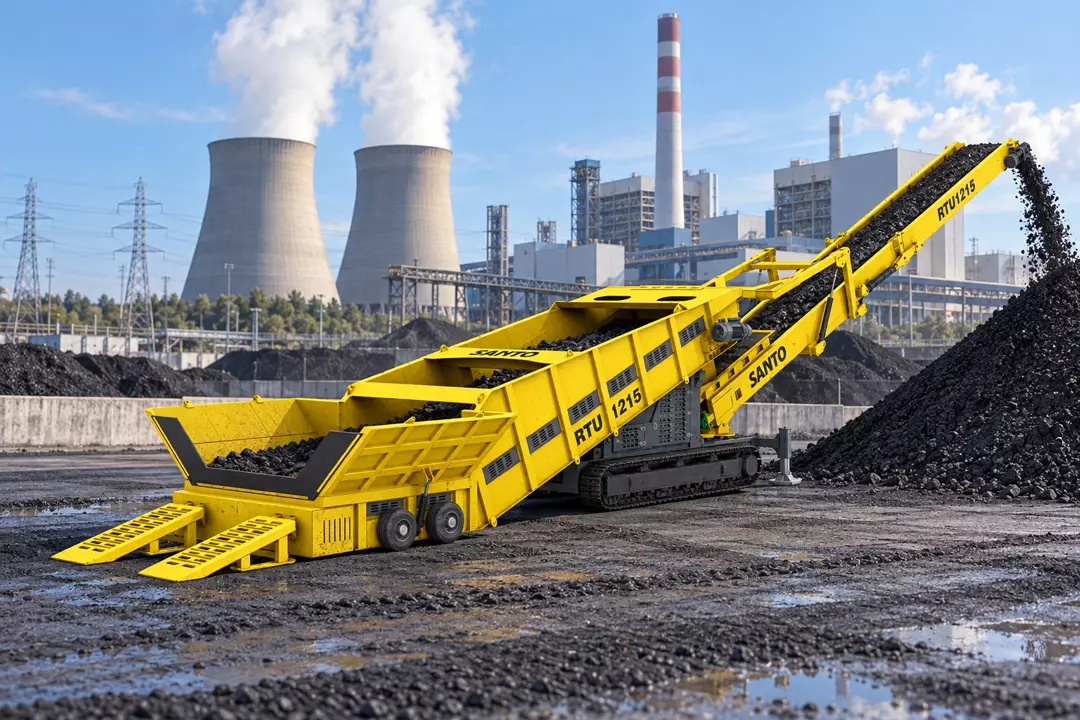
The truck tips coal directly into the unloader’s receiving section. The same machine carries the material through its integrated conveyor to the discharge point.
The SANTO Radial Truck Unloader provides this direct receiving arrangement. Its RTU1215 model has a 1,200 mm belt, 15 m conveyor length and 7.1 m listed stacking height.
A direct route can avoid an intermediate ground pile and the loader task needed to recover it. Check truck access, tipping clearance and discharge reach before choosing this arrangement. Add a transfer conveyor only when the distance or receiving geometry requires one.
Feed Coal from a Stockpile with a Wheel Loader
Wheel Loader → Hopper Feeder → Existing Plant Conveyor
The wheel loader collects coal from storage and delivers it to the hopper. The feeder regulates material flow into the downstream conveyor.
Match the receiving hopper to the loader bucket, dumping position and coal characteristics. Check whether the loader can maintain the required supply rate throughout the operating period.
The loader performs the reclaiming task. The hopper feeder receives and conveys the coal; it does not excavate the stockpile.
Transfer Coal Between Receiving and Storage Areas
Receiving Equipment → Transfer Conveyor → Stockpiling Conveyor
Use connecting conveyors when the receiving point sits away from the coal yard or plant intake. Check the receiving height and discharge position at every handover.
Mobile reception feeders, connecting conveyors and stockpiling equipment all have established roles in power-station material handling. Select the combination around the actual route.
Match Conveyor Capacity to Your Coal and Operating Schedule
Daily tonnage alone does not define the required conveying rate. Truck gaps, loader movements, inspections and interruptions reduce the time available for moving coal.
Calculate the Required Operating Throughput
Consider an illustrative planning example, using metric tonnes:
| Input or calculation | Example |
|---|---|
| Required daily coal movement | 2,400 t |
| Scheduled handling window | 8 h |
| Assumed proportion of time actively conveying | 80% |
| Effective conveying time: 8 × 0.80 | 6.4 h |
| Required average rate while conveying: 2,400 ÷ 6.4 | 375 t/h |
Under these assumptions, the route must average 375 t/h during active conveying.
A sustained rate of 300 t/h over the same 6.4 hours would move 1,920 t, leaving a 480 t shortfall. This comparison shows why a conveyor rating must match the operating schedule as well as the daily target.
The example does not specify a final equipment size. Check peak feeding rates, operating variation and downstream limits before selecting capacity.
Check Bulk Density, Moisture and Lump Size
A coal conveyor belt system must accommodate both mass flow and the volume of material on the belt.
If the example coal has an assumed bulk density of 0.8 t/m³:
375 t/h ÷ 0.8 t/m³ = 468.75 m³/h
Replace this density with your measured material value. Also provide maximum particle size in millimetres, moisture content and the proportion of fines.
These calculations illustrate a selection method. They do not represent measured SANTO production results or universal coal properties.
Select SANTO Equipment for Each Handling Stage
Assign each machine a specific receiving, feeding, transfer or stockpiling role. Then check how the machines work together.
Truck Unloaders for Direct Coal Reception
A radial truck unloader combines truck reception and conveying in one machine. This arrangement suits projects where road vehicles can approach the intake and the discharge can reach the intended destination.
Check the truck’s tipping position, vehicle circulation and receiving-point clearance. A machine’s maximum stacking height does not, by itself, confirm compatibility with an existing plant inlet.
Hopper Feeders for Controlled Coal Feeding
The SANTO Feeder Track Stacker receives material from feeding equipment and regulates flow through its feeder.
SANTO’s published model table lists 1,000 mm and 1,200 mm belt widths, with 15 m and 20 m conveyor lengths. Select the configuration around the loader, coal properties and downstream requirement.
Transfer Conveyors and Radial Stackers
Transfer conveyors connect handling positions. Radial stackers distribute material within a storage area. The following published model examples provide a starting point for comparison:
| Model | Equipment | Belt width | Conveyor length | Listed capacity |
|---|---|---|---|---|
| RTU1215 | Radial Truck Unloader | 1,200 mm | 15 m | 700 t/h |
| FTS1015 | Feeder Track Stacker | 1,000 mm | 15 m | 500 t/h |
| JC1030 | Grasshopper Conveyor | 1,000 mm | 30 m | 500 t/h |
| TS1024R | Tracked Radial Stacker | 1,000 mm | 24 m | 500 t/h |
These figures describe the individual product models. They do not guarantee the same throughput for every coal type, inclination or site arrangement.
For a single series route, do not add the machines’ capacities together. The lowest-capacity stage can constrain the route, while interrupted feeding can reduce the average rate further.
Plan Coal Stockpiling and Loader-Assisted Reclaiming
A stockpile separates incoming deliveries from plant demand. It also creates a later reclaiming task, so plan storage and recovery together.
Position the Stacker Around the Storage Area
The SANTO Tracked Radial Stockpiler provides a mobile stockpiling option. SANTO lists the TS1024R with a 24 m conveyor and 10.7 m stacking height.
Use these dimensions as initial layout inputs. They do not establish a suitable coal pile height or storage capacity for your site.
Allocate space for:
- The stacker’s operating movement.
- Vehicle access and loader travel.
- Separation between coal grades or delivery batches.
- Inspection, maintenance and stockpile management.
- Access to the coal that the plant needs next.
Return Stored Coal to the Plant Receiving Line
A loader-assisted route can return stored coal to a plant conveyor:
Coal Stockpile → Wheel Loader → Hopper Feeder → Plant Receiving Conveyor
Check the loader’s travel distance, bucket cycle and receiving position. A large conveyor cannot compensate for a feeding operation that supplies too little coal.
If the project needs a temporary alternative route during maintenance, review its capacity, controls and receiving interfaces before treating it as a usable backup.
Connect Mobile Conveyors to the Existing Power Plant Conveyor
A suitable power plant conveyor connection needs compatible geometry, flow and controls. Confirm these interfaces before finalising the equipment arrangement.
| Interface | Information to confirm |
|---|---|
| Receiving point | Inlet position, opening dimensions and receiving height |
| Material flow | Permitted continuous rate and peak feed rate |
| Transfer route | Horizontal distance, elevation changes and obstacles |
| Electrical supply | Voltage, frequency and available power |
| Controls | Start/stop sequence, downstream status signals and interlocks |
| Site access | Vehicle routes, equipment positioning and maintenance space |
A SANTO Jump Conveyor can connect separate handling stages where the layout suits its transfer geometry.
The current product range lists conveyor lengths from 20 to 35 m. For example, SANTO lists the JC1030 with a 30 m conveyor length and 29.7 m horizontal distance. Neither figure alone establishes the usable distance between two plant interfaces; transfer overlap and equipment positions also matter.
Define the supply boundary clearly. Complete in-plant coal systems can include unloading facilities, crushing, transfer towers and ancillary equipment. Identify which existing systems remain responsible for those functions when adding mobile equipment.
Review Dust Control, Spillage and Maintenance Requirements
Coal-handling projects need material-specific and site-specific operating requirements. Include these requirements in the equipment enquiry.
Manage Dust at Receiving and Transfer Points
Review truck tipping, hopper loading, conveyor handovers and final discharge. Identify where falling coal releases dust or escapes the intended material path.
Evaluate transfer enclosures, chute geometry, sealing, belt cleaning and suitable dust-control methods as part of the project design. Do not assume that every machine includes the same options.
NIOSH’s dust-control handbook discusses control methods across conveying and other bulk-material processes. Its focus is industrial minerals, so apply its principles through a coal-specific assessment.
Specify Coal-Related Fire and Dust Protection Requirements
OSHA identifies coal among materials that can present an explosion hazard in dust form under suitable conditions.
Provide the site’s hazard assessment and applicable project requirements. Have qualified specialists determine the necessary protection, monitoring and equipment specifications.
Confirm required certification and configuration in the proposal. Do not infer them from the equipment name or appearance.
Provide Access for Inspection and Maintenance
Plan access to belts, pulleys, rollers, transfer points and cleaning areas. Include guarding, isolation arrangements and maintenance procedures in the site review.
CEMA’s conveyor safety resources support these activities alongside site-specific risk assessment and training.
What Determines the Cost of a Coal Conveyor System?
Equipment price depends on the complete handling requirements. Two projects with the same daily tonnage can need different machinery and site work.
The main cost factors include:
- The number of receiving, transfer and stockpiling stages.
- Required capacity, belt width and conveyor length.
- Intake and discharge geometry.
- Mobility and power configuration.
- Coal characteristics and specified protection measures.
- Transport, installation, civil works and control integration.
Compare proposals against the same material data, route and supply boundary. Include operating costs such as energy, loader use, cleaning and maintenance when comparing alternatives.
A short direct-transfer route may reduce equipment and handover points. A longer route may need additional conveyors to reach the destination. A dimensioned site drawing helps SANTO Machinery identify those requirements before preparing a quotation.
Coal Conveyor System FAQs
What is a coal conveyor system?
A coal conveyor system uses conveying equipment to move bulk coal between handling stages. A mobile layout combines truck reception, hopper feeding, transfer and stockpiling.
Can mobile conveyors feed an existing power plant conveyor?
Yes, a project can use mobile equipment to feed an existing conveyor when the interfaces match. Check the receiving height, discharge reach, permitted feed rate, power supply and control requirements.
How do you select the capacity of a coal handling conveyor?
Divide the required tonnage by the effective conveying time. For example, 2,400 t over 6.4 active hours requires an average of 375 t/h while conveying.
Can the same conveyor handle wet coal and fine coal?
Suitability depends on the actual material and equipment configuration. Moisture, fines and particle size can change how coal flows through a hopper or transfer point.
Can a mobile stacker reclaim coal automatically?
No, a mobile stacker places material into storage, can’t automatically excavate coal from the pile.
Request a Coal Handling Layout for Your Power Plant
Share where your coal arrives, where it must go and how much you need to handle. SANTO can discuss equipment options around your material and site interfaces.
Include:
- Coal type, moisture content and maximum lump size.
- Bulk density in t/m³.
- Required capacity in t/h and daily operating hours.
- Truck, loader or existing-conveyor feeding method.
- Transfer distance and height difference.
- Plant receiving-point drawings.
- Site layout and available power supply.
Contact SANTO to request a coal handling proposal.
External References