
Radial Stacker Conveyor: Working Principles, Types & Selection
- Updated 2026-10-31
- Source:
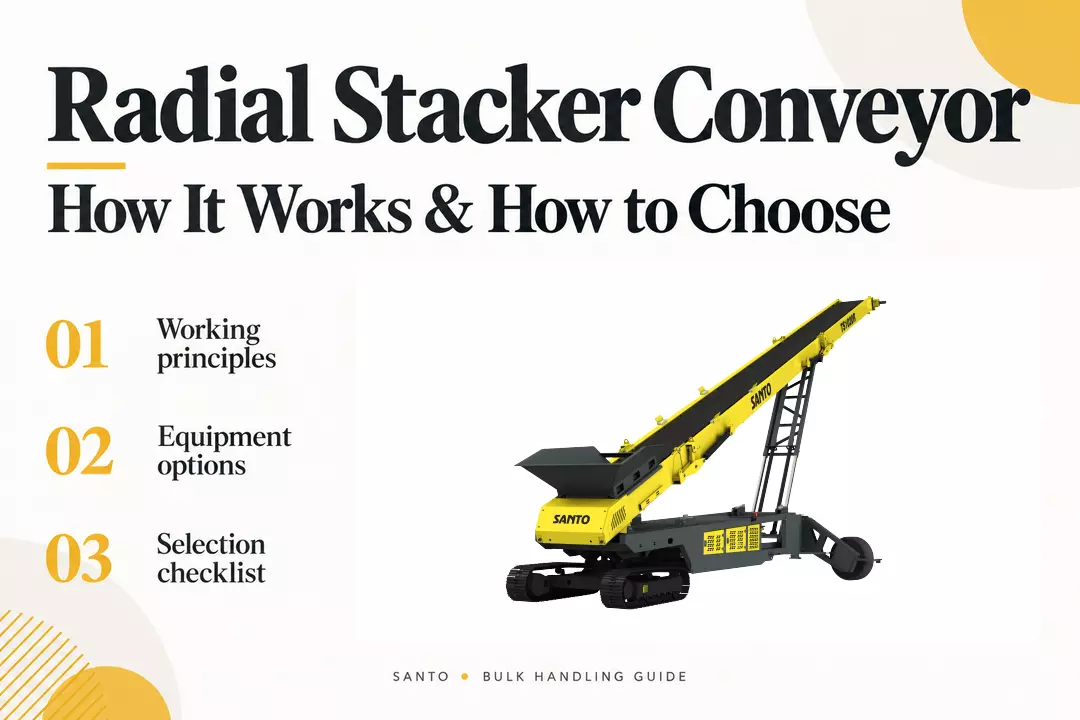
A radial stacker conveyor carries bulk materials along a belt and swings its discharge end through an arc to build a wider pile. Quarries, mines and bulk handling terminals use these conveyors to organise storage, maintain production flow and reduce repeated loader movements.
Choosing the right equipment requires more than a tonnes-per-hour figure. Material characteristics, available space, hydraulic functions, motor requirements and mobility all influence the configuration you need.
Within SANTO’s range of mobile stacking conveyors, radial equipment serves operations that need to distribute bulk materials around a relatively stable receiving point. This guide explains how the equipment works, compares mobile and portable configurations, and identifies the information you need to assess capacity and price.
What Is a Radial Stacker Conveyor?
A radial stacker conveyor pivots near its receiving end and moves its discharge end sideways to spread loose bulk solids across a storage area.
A conveyor with a fixed discharge position builds a pile beneath one point. Radial movement shifts that point along an arc, allowing the operator to use more of the surrounding yard.
Typical components include:
| Component | Main function |
|---|---|
| Receiving section | Accepts the incoming flow from upstream equipment |
| Conveyor belt and drive motor | Carry the load toward the discharge end |
| Frame and idlers | Support the belt and its load |
| Pivot arrangement | Establishes the centre of radial movement |
| Radial travel mechanism | Moves the discharge end through its operating arc |
| Hydraulic elevation system, where fitted | Adjusts the conveyor angle and discharge height |
“Radial stacker”, “radial stacking conveyor” and “radial stockpiler” describe closely related equipment. However, radial identifies a movement capability, not a particular chassis or control system.
A radial stacker can combine a fixed-length or telescopic conveyor with tracks, wheels or another supporting arrangement. Check each feature separately when comparing specifications.
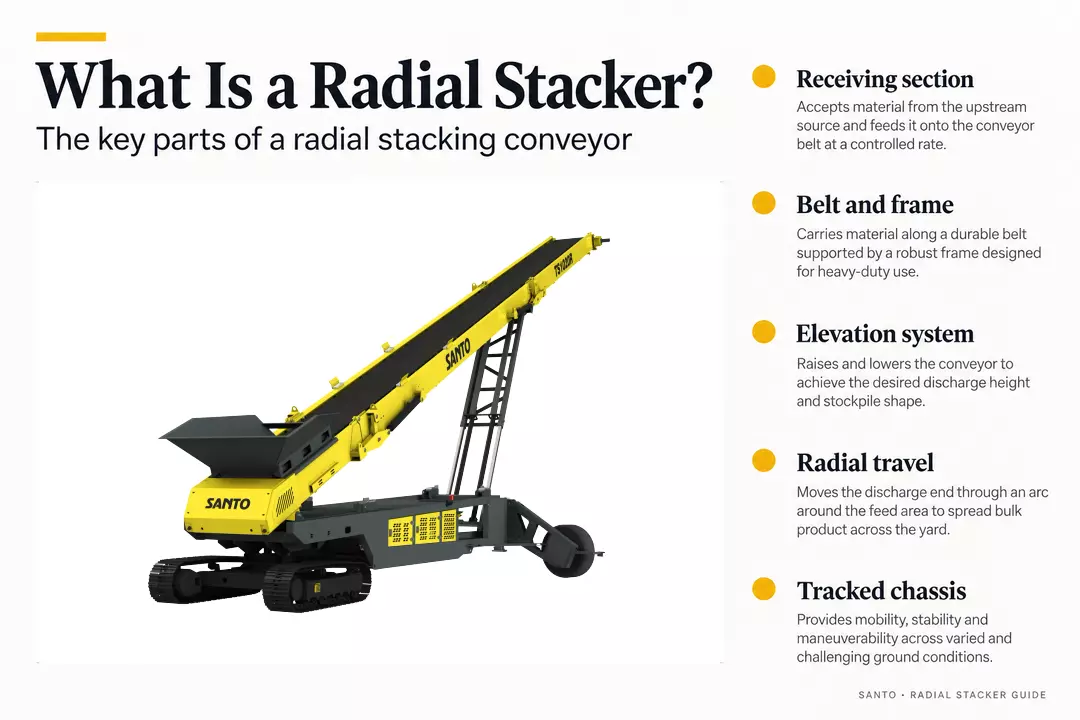
Tracked radial stacker with receiving hopper, belt, elevation system and chassis
How Does a Radial Stacker Conveyor Work?
The belt receives and transports the incoming product, while the radial mechanism changes the discharge position to build the pile progressively.
The operation combines controlled feeding, continuous conveying and coordinated movement.
Receiving the bulk feed
A crusher, screen, hopper feeder or transfer conveyor supplies the stacker. The receiving section must accommodate the incoming stream’s position, lump size and short-term flow changes.
Where the processing plant sits away from the storage area, mobile transfer conveyors can connect the two. Match the transfer heights and loading conditions throughout the proposed operating arrangement.
Driving the belt
The belt drive motor supplies the power that moves the load along the frame. The required drive arrangement depends on throughput, conveyor length, incline, operating resistance and starting conditions.
Do not select a motor from the advertised capacity alone. Ask the supplier to explain the drive rating and the conditions that support it.
Consistent feeding also matters. Sudden surges can overload the receiving section even when the average production rate remains below the published capacity.
Moving the discharge end
Radial travel changes the horizontal discharge position. A hydraulic luffing system, where fitted, raises or lowers the conveyor. Telescopic equipment adds extension and retraction.
| Movement | What it changes |
|---|---|
| Radial travel | Discharge position around the pivot |
| Hydraulic elevation adjustment | Conveyor angle and discharge height |
| Telescopic extension | Reach along the conveyor’s length |
| Chassis travel | Position of the entire machine on site |
Check which functions the quotation includes. Powered movement, remote control and automatic stacking programs represent different capabilities.
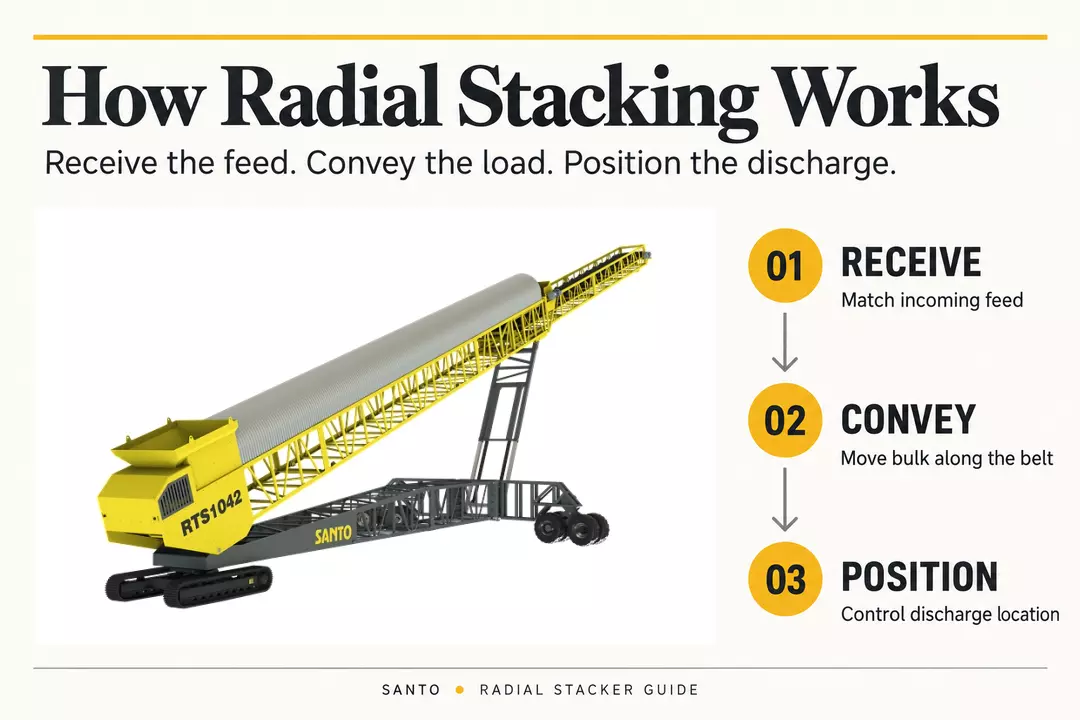
Radial telescopic stacker working process
Should You Choose Fixed-Length or Telescopic Radial Conveyors?
Choose fixed-length radial conveyors when their working arc meets your storage needs. Consider telescopic equipment when you need additional control over discharge reach and pile formation.
Both configurations can perform radial stacking. The main difference concerns how they position the discharge point along the conveyor’s length.
Fixed-length radial conveyors
A fixed-length machine maintains the same conveyor length during operation. Radial travel spreads the discharge sideways, while an elevation system, where fitted, adjusts its height.
SANTO’s tracked radial stacker range includes the TS820R with a published length of 20 m, stacking height of 9.4 m, belt width of 800 mm and capacity of 300 t/h.
These specifications describe that model. They do not establish a universal relationship between belt width and throughput.
Telescopic radial conveyors
A telescopic machine extends or retracts its reach. Together with radial travel and elevation adjustment, this movement gives the operator more control over where the product lands.
Telestack reports up to 30% more stockpile capacity in the same footprint for its radial telescopic equipment, based on the comparison described on its product page, including trapezoidal stacking. This manufacturer-specific figure does not guarantee the same improvement at every installation.
Compare proposed layouts using the same feed properties, available footprint and inventory requirement. Otherwise, different assumptions can make one configuration appear more suitable than it actually is.
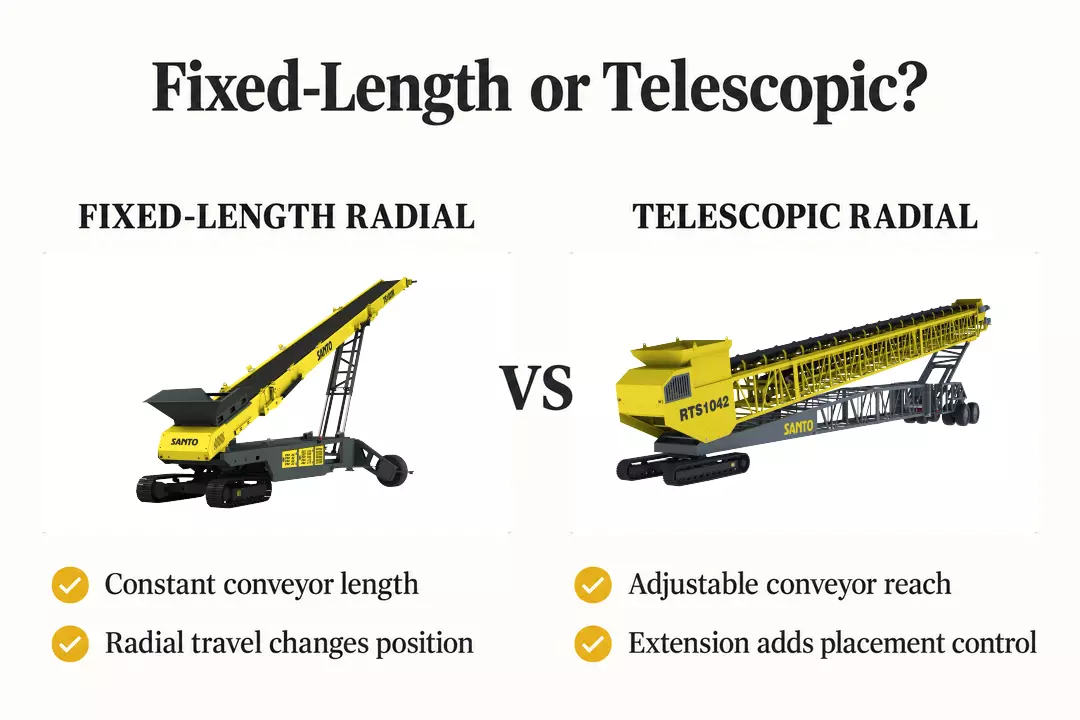
Fixed-length radial stacker and telescopic radial conveyor comparison
Do You Need a Mobile or Portable Radial Stacker?
Choose mobility around how often you reposition the equipment and how you transport it between sites. Confirm the actual travel and setup arrangements rather than relying on “mobile” or “portable” labels.
Suppliers may use these terms differently. A mobile machine may provide powered chassis travel, while a portable configuration may depend on towing, folding or transport on another vehicle.
An industrial bulk-handling conveyor also differs from a small conveyor cart intended for light-duty handling. Compare the operating duty before comparing size or price.
Tracked configurations
A suitable tracked chassis allows the operator to reposition the machine under its own power. This can help when the stacker needs to follow a mobile crusher or screen.
Tracks do not automatically provide radial stacking. The machine still needs the appropriate pivot and radial travel mechanism.
Wheeled configurations
A wheeled arrangement may suit radial operation around a prepared pivot, site relocation or transport requirements, depending on its design.
SANTO lists the RWS1042 with a conveyor length of 42 m, stacking height of 17.6 m and working angle of 7°–23°. Review the complete wheeled telescopic configuration against your ground conditions and available working space.
Portable transport arrangements
A long working conveyor does not necessarily require the same transport length. Folding frames can reduce the transport envelope.
For example, Astec offers top-folding frames on radial stackers from 80 to 150 ft. The folding arrangement, axle configuration and transport package still determine how each machine moves between projects.
Before selecting portable equipment, confirm transport dimensions, weight, loading procedures and setup clearances.
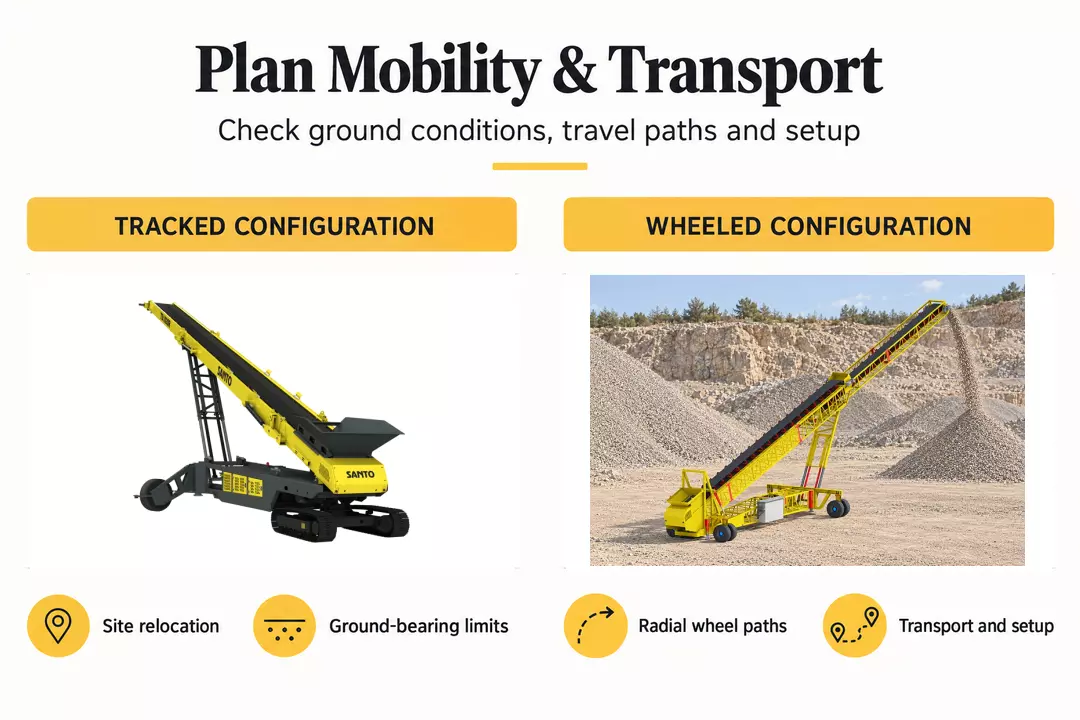
Tracked and wheeled radial stacking conveyors compare
How Do You Select the Right Belt Width, Length and Capacity?
Size the conveyor around bulk density, particle size, normal and peak throughput, required reach and stacking height. Verify the published capacity against your actual operating conditions.
Start with material characteristics, then review the complete conveying arrangement.
Define the bulk material
Provide the supplier with:
- Material type and loose bulk density.
- Maximum lump size and particle-size distribution.
- Typical moisture content.
- Abrasiveness and tendency to stick.
- Temperature and any special handling requirements.
A lower-density material occupies more belt volume at the same mass flow rate. Large lumps can also introduce loading, clearance and belt-selection constraints.
Match normal production and peak flow
Distinguish normal production from the highest short-term flow that reaches the stacker.
Review crusher discharge, screen output, feeder settings and any buffering between machines. Check whether the receiving section can manage surges without spillage.
Compare the full specification
SANTO publishes the following reference figures:
| Model | Configuration | Belt width | Conveyor length | Stacking height | Capacity |
|---|---|---|---|---|---|
| TS820R | Tracked radial stacker | 800 mm | 20 m | 9.4 m | 300 t/h |
| TS1024R | Tracked radial stacker | 1,000 mm | 24 m | 10.7 m | 500 t/h |
| RTS1042 | Radial telescopic stacker | 1,000 mm | 42 m | 14.5 m | 500 t/h |
| RTS1242 | Radial telescopic stacker | 1,200 mm | 42 m | 14.5 m | 700 t/h |
Sources: SANTO tracked radial specifications and SANTO telescopic conveyor specifications.
The TS1024R and RTS1042 both list 500 t/h, but their lengths and stacking heights differ. The capacity figure alone therefore cannot determine which machine fits the yard.
SANTO identifies its website parameters as reference data. Confirm the final specification, motor arrangement and capacity-rating conditions in the project quotation.
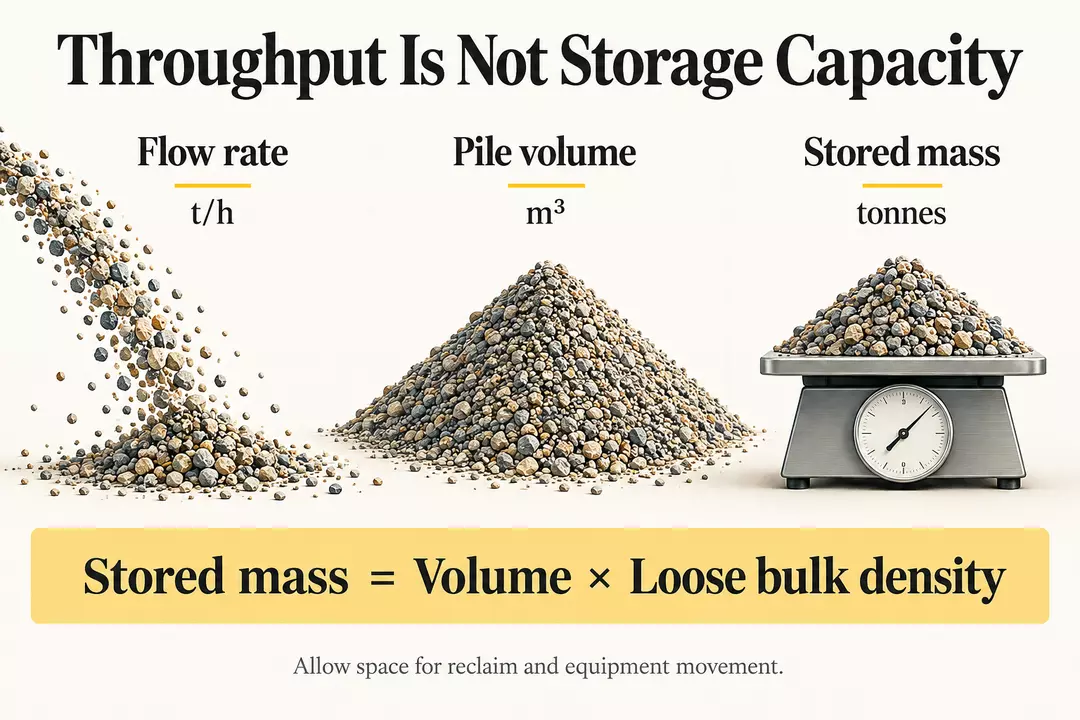
Comparing throughput, pile volume and stored mass
How Much Bulk Material Can a Radial Stacker Store?
Storage capacity depends on pile geometry, loose bulk density and usable yard space. Hourly conveying capacity measures flow, not the quantity the yard can hold.
Keep these measurements separate:
| Measurement | Meaning | Typical metric unit |
|---|---|---|
| Throughput | Mass passing through the conveyor per unit of time | t/h |
| Pile volume | Space occupied by the stored product | m³ |
| Stored mass | Total mass within that volume | tonnes |
Calculate volume before converting to tonnes
For a simple conical pile:
Volume = π × radius² × height ÷ 3
Then estimate the stored mass:
Stored mass = volume × loose bulk density
Use a density that reflects the actual storage condition. Solid rock density does not represent the bulk density of loose crushed aggregate.
The cone formula explains a basic geometry. It does not calculate the full swept volume of every radial or telescopic arrangement.
Check published capacity assumptions
Marco publishes storage volumes of 9,549 m³ for its 80 ft radial stacker and 18,429 m³ for its 100 ft machine. These equipment-specific figures do not provide a general conversion from conveyor length to storage capacity.
Before using a brochure value, confirm the radial angle, discharge height, angle of repose, ground profile and telescopic position.
Allow space for reclaim and movement
The yard must accommodate wheel paths, drainage, product separation and loader access as well as inventory.
Establish the required storage from the production and dispatch schedule. Then connect stacking with reclaim and loading activities within the overall aggregate conveying layout.
Where Do Radial Stacker Conveyors Work Best?
Radial stacker conveyors suit bulk operations that need continuous discharge across a wider storage area and can accommodate the machine’s operating arc.
They can help where a fixed discharge point restricts production or forces loaders to relocate freshly processed product repeatedly. The table below shows the main application areas for radial stacking conveyors:
| Application | Potential benefit | Main selection check |
|---|---|---|
| Crushed stone production | Spreads finished aggregate across a wider area | Peak output and product separation |
| Sand and gravel processing | Organises storage after processing | Moisture, drainage and loading conditions |
| Ore handling | Connects continuous conveying with bulk storage | Density, abrasion and structural requirements |
| Processed recycled aggregates | Supports changing work areas | Variable grading, contaminants and feed consistency |
| Ports and terminals | Supports shore-side buffering or a broader loading system | Yard access and interfaces with downstream equipment |
Can You Use a Radial Stacker for Ship Loading?
A suitable radial conveyor can form part of a ship-loading system, but stockyard capability alone does not establish suitability for loading a vessel.
Ship loading introduces additional requirements, including vessel position, hatch reach, changing discharge geometry and continuity of the shore-side supply. (Related Solution: Mobile ship loading conveyor for ports and terminals >>)
The supplier must review the complete route from truck intake or storage to the ship. Check the conveyor’s reach, loading rate, transfer arrangements and operating clearances against the proposed vessel and berth.
For projects that combine bulk storage with vessel loading, use a dedicated ship-loading conveyor selection guide to assess these additional interfaces.
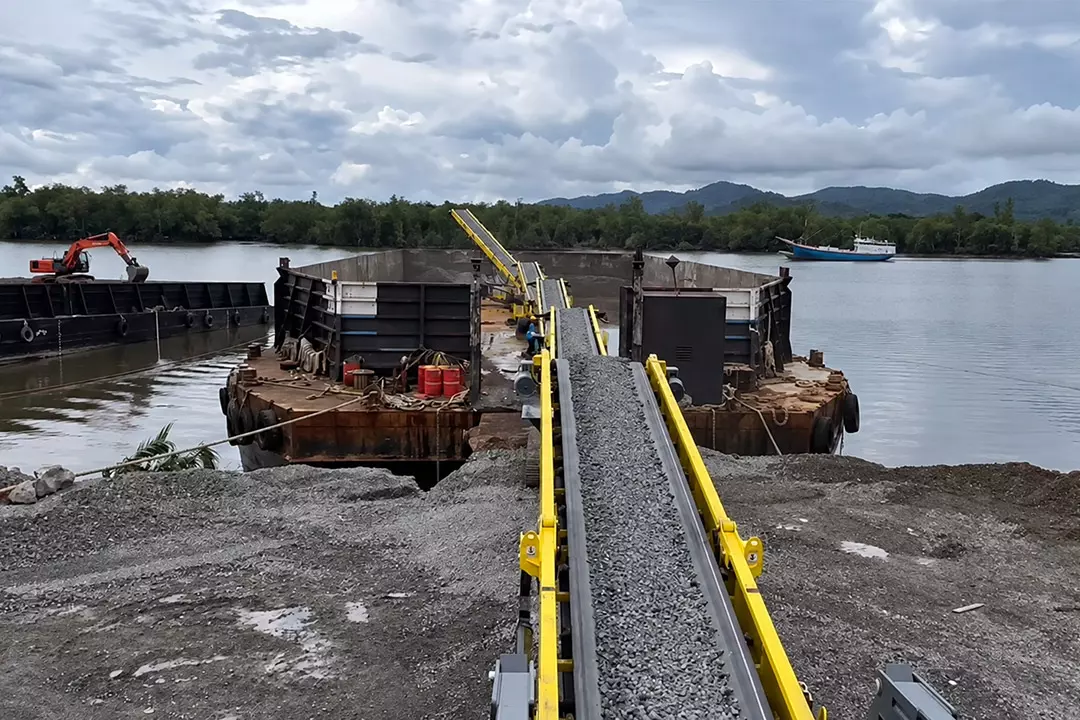
Mobile ship loading conveyor system
How Do You Reduce Segregation, Dust and Product Damage?
Control the drop distance, build the pile progressively and guide the feed through well-designed transfer points. Radial movement alone does not eliminate segregation or dust.
Equipment features and operating practices must work together.
Control discharge height
Coarse particles can roll farther down a pile than fine particles. Uncontrolled discharge can therefore separate aggregate by particle size.
The Indiana Department of Transportation recommends keeping the conveyor end less than 1 m above the pile in its radial-stockpiling guidance and raising the conveyor as the pile grows. It also describes small horizontal movements and recognises that side-slope segregation can still occur. Apply this guidance within the machine’s operating limits and site procedures.
Where the equipment provides hydraulic elevation adjustment, use it within the approved operating procedure to manage discharge position as storage builds.
Coordinate reclaim practices with the stacking method. Selective removal from one part of a pile can reduce consistency even when the original placement was careful.
Improve transfer-point control
Guide the incoming stream toward the centre of the receiving belt. Limit unnecessary free fall and contain the flow through the transfer.
NIOSH’s dust-control handbook explains the importance of centred loading, compatible feed direction and belt movement, and reduced transfer drop distance. These principles help control the handover between conveyors.
Depending on the application, consider suitable skirting, chute geometry, belt cleaning, enclosures and dust extraction or suppression.
Choose controls around product sensitivity and moisture limits. Water addition may suit some bulk materials and create problems for others.
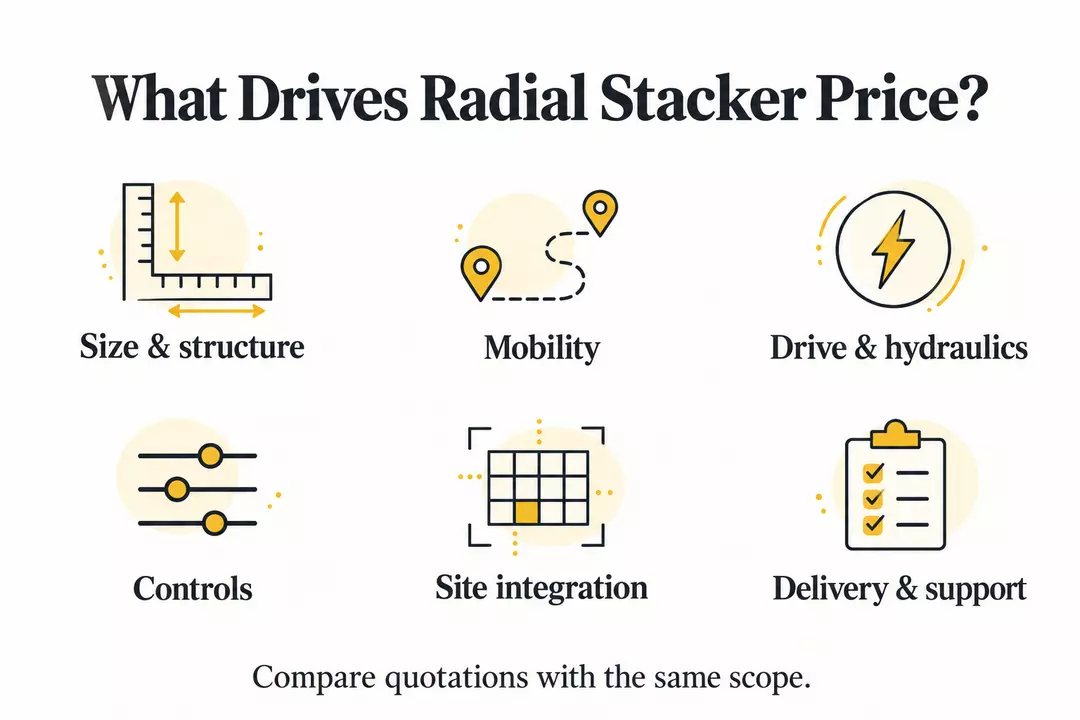
Radial stacker conveyor price factors covering size, mobility, hydraulics, controls, integration and delivery
What Affects the Price of a Radial Stacker Conveyor?
Conveyor dimensions, mobility, hydraulic equipment, drive motors, telescopic functions and control options influence the purchase price. Installation scope and operating conditions determine the wider project cost.
Compare quotations against an identical scope.
| Price factor | What to compare |
|---|---|
| Conveyor structure | Length, belt width, frame design and wear protection |
| Mobility | Tracks, wheels, radial travel and transport arrangements |
| Hydraulic system | Elevation, radial movement and other specified functions |
| Drive package | Belt motor, power source and starting arrangement |
| Telescopic functions | Extension mechanism and associated components |
| Controls | Local operation, remote control and automatic programs |
| Integration | Feed interfaces, transfer conveyors and electrical connections |
| Delivery and support | Freight, assembly, commissioning, training and spare parts |
A lower equipment price does not necessarily produce a lower handling cost. Energy, wear, maintenance, downtime and remaining loader work all influence the result.
When you contact suppliers for pricing, identify whether you need an equipment-only quotation or a complete installed package. This prevents scope differences from distorting the comparison.
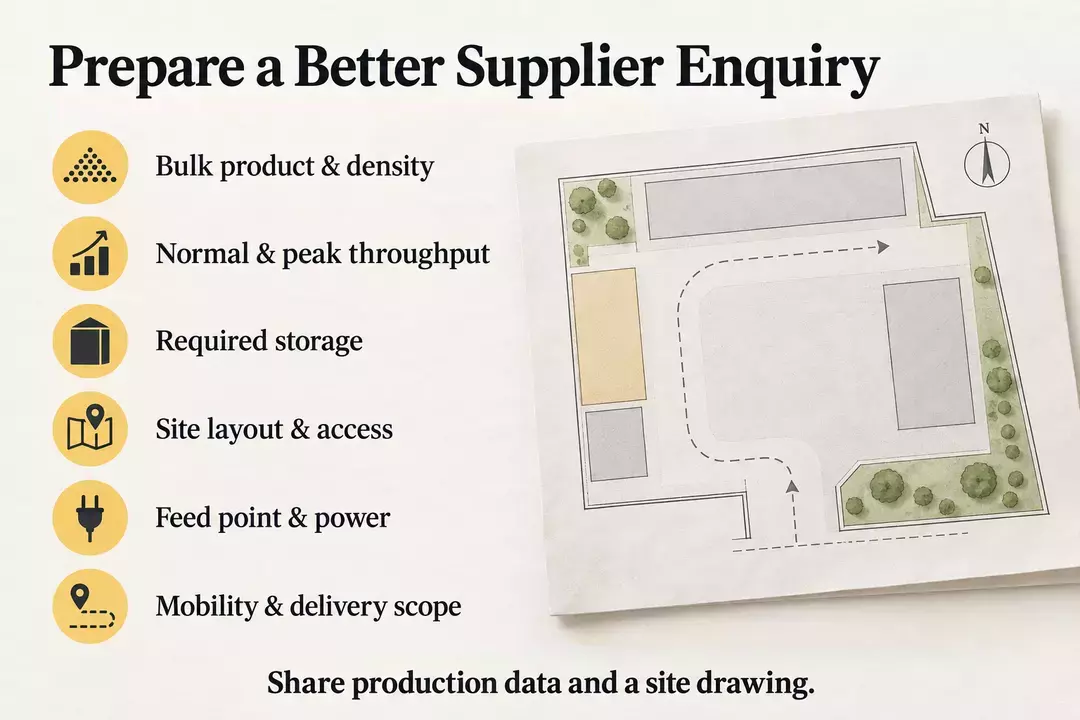
Radial stacker quotation checklist for bulk density, throughput, storage, site layout, power and delivery
What Should You Prepare Before You Contact a Supplier?
Prepare your bulk-product data, throughput requirements, target inventory and site drawing. These details allow the supplier to assess performance, layout and price together.
Include the following information in your enquiry:
| Information | Details to provide |
|---|---|
| Bulk product | Type, loose density, particle sizes and moisture |
| Production | Normal rate, peak rate and operating schedule |
| Storage | Required inventory, height limits and product separation |
| Site layout | Available footprint, obstacles, access and ground conditions |
| Feed arrangement | Upstream equipment, discharge position and receiving height |
| Mobility | Relocation frequency and transport between projects |
| Power | Available electrical supply or other required power arrangement |
| Controls | Operator location, remote operation and integration requirements |
| Environmental needs | Dust, spillage, drainage and quality requirements |
| Delivery scope | Transport, installation, commissioning and training |
A marked site plan can reveal conflicts between the pile, radial wheel path and reclaim route before equipment selection progresses.
Contact SANTO for a configuration review with your production requirements and yard drawing to discuss a suitable mobile or portable radial stacking arrangement.
Frequently Asked Questions.
Does every mobile stacker provide radial movement?
No. Mobile describes the ability to relocate. Radial stacking requires a suitable pivot and travel mechanism.
Does every telescopic conveyor provide radial travel?
No. Telescoping changes reach. Radial travel changes the discharge position around a pivot.
Can radial conveyors connect to existing crushers and screens?
Yes, when capacities, receiving heights and discharge trajectories match. Must review connection throughout the operating range and confirm the required control interlocks.
Does a larger motor automatically increase conveyor capacity?
No. It doesn’t. Belt loading, speed, incline, structure, feed conditions and other components also constrain performance.
External References: