


Ship Loading Conveyor Systems: Types & Selection Guide
- Updated 2026-10-20
- Source:
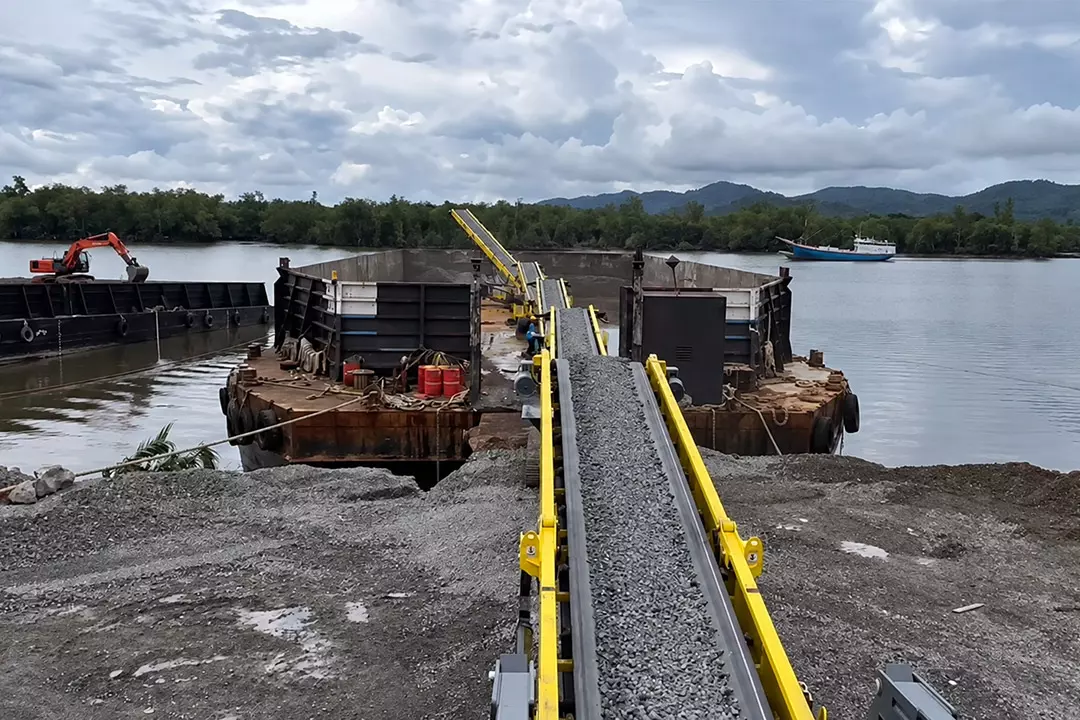
A ship loading conveyor transfers dry bulk cargo from a shore-side receiving point into a ship or barge. A complete system connects material receiving, controlled feeding, transfer conveyors and a loading boom. Its movement mechanisms position the discharge above the vessel’s holds.
Choosing a system requires more than comparing conveyor capacities. You need to match the loading rate, material properties, vessel dimensions and berth layout.
This guide explains how to compare configurations and calculate the requirements that influence selection. For application-specific equipment arrangements, explore SANTO’s ship loading solutions for ports and terminals.
How Does a Ship Loading Conveyor Move Material into a Vessel?
A ship loading conveyor carries bulk cargo from a receiving hopper or upstream conveyor to a discharge point above the vessel. A feeder controls the flow, transfer conveyors move the cargo toward the berth, and the loading boom and chute direct it into the selected hold.
A typical loading line follows these steps:
- Receive the material. A truck unloader, hopper or upstream conveyor accepts the incoming cargo.
- Control the feed. A feeder regulates the flow into the conveying line.
- Transfer the cargo. Connecting conveyors carry the material toward the berth.
- Position the discharge. The shiploader adjusts its location, boom angle or outreach to reach the selected hold.
- Load the vessel. A chute directs the material into the hold.
- Adjust the loading position. Operators follow the vessel’s loading plan as cargo levels rise and loading moves between holds.
The conveyor carries the material. The shiploader includes the conveyor, supporting structure, positioning mechanisms, discharge equipment and controls.
Evaluate the entire route. A high-capacity boom cannot compensate for a receiving hopper that repeatedly runs empty.
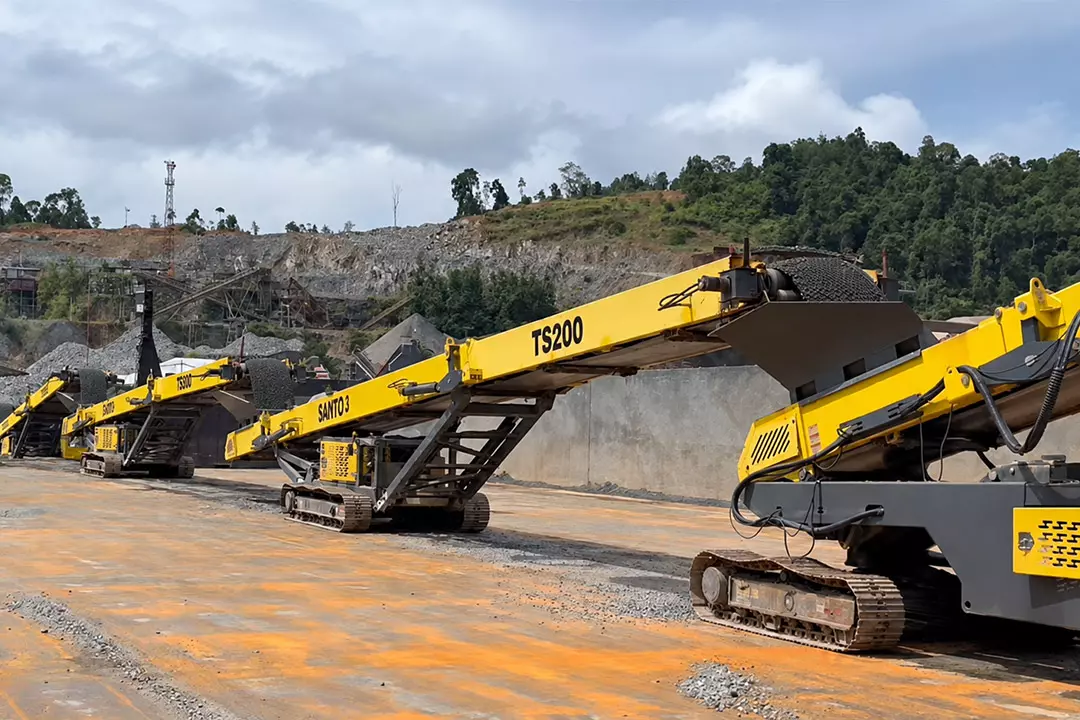
Mobile conveyor system for ship loading
Which Type of Ship Loading Conveyor Does Your Port Need?
Choose a fixed system for a permanent loading position, a mobile system when you need relocation flexibility, or a rail-mounted shiploader for travel along a dedicated berth.
Add radial movement, telescoping or luffing according to the hatch positions and discharge heights you need to reach. These options can work together. For example, a mobile shiploader can combine radial travel with a telescopic, luffing boom. (Study Case: Mobile Radial Telescopic Stacker for Port Loading in Brazil >>)
The table below shows functions of these features, as well as factors to consider when making a choice:
| Configuration or function | What it does | Main selection consideration |
|---|---|---|
| Fixed installation | Loads from a permanent position | Confirm hatch access and any vessel-shifting requirements |
| Mobile chassis | Relocates the machine on wheels or tracks | Check quay loads, travel routes and feeding connections |
| Rail-mounted travel | Moves the shiploader along the berth | Assess rail infrastructure and longitudinal hatch coverage |
| Radial movement | Moves the discharge through an arc around a pivot | Reserve clear space for the machine’s operating sweep |
| Telescopic boom | Extends and retracts the conveyor | Match horizontal reach to hatch positions |
| Luffing boom | Raises or lowers the boom angle | Check discharge height and clearance throughout loading |
| Slewing structure | Rotates the boom horizontally around its supporting structure | Check rotation limits and surrounding obstructions |
Fixed Ship Loading Conveyors
A fixed system suits a loading point with predictable vessel positions and a consistent material supply.
Its main limitation concerns coverage. If one discharge point cannot reach all required positions, the project may need additional loading points or vessel movement.
Compare those operating requirements with the simplicity of a permanent installation.
Mobile Ship Loading Conveyors
Mobile machines allow operators to relocate equipment between loading positions or clear a shared berth after use.
They suit terminals that handle seasonal cargo, serve multiple loading locations or need flexible layouts. However, mobility still requires adequate pavement strength, turning space and practical power connections.
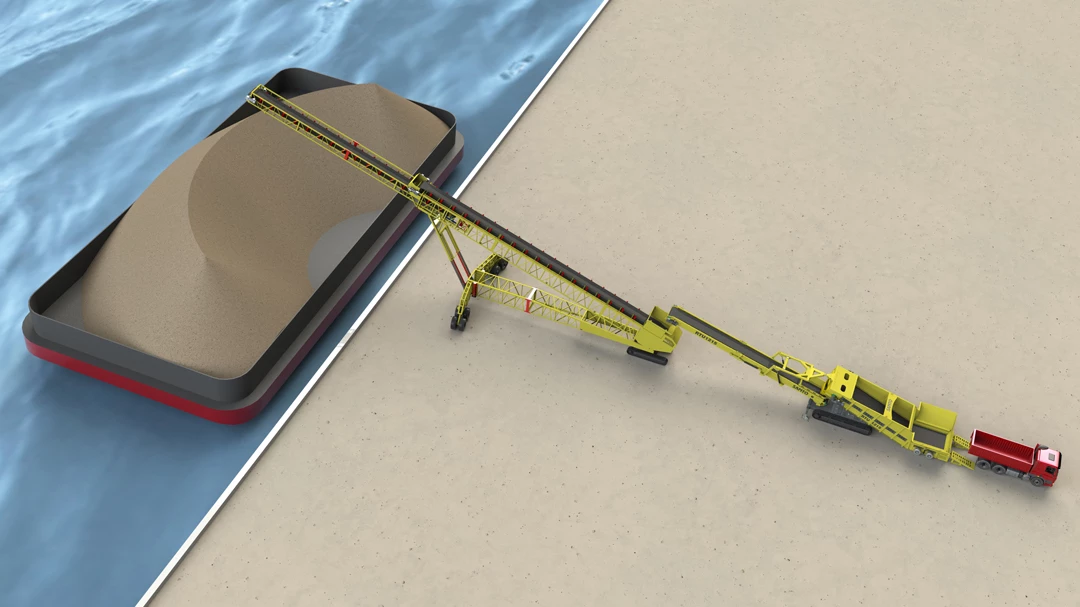
Radial and telescopic ship loading conveyor system diagram
Radial and Telescopic Ship Loading Conveyors
Radial movement changes the discharge position across an arc. Telescoping changes the boom’s reach. Combining these functions gives operators more control over where cargo enters a hold.
SANTO describes radial telescopic arrangements that support hatch trimming and movement between loading positions. Actual coverage depends on the selected machine and vessel geometry.
SANTO’s wheeled radial telescopic stacker provides the following published reference specifications:
| Model | Belt width | Published conveyor length | Published capacity |
|---|---|---|---|
| RWS1036 | 1,000 mm | 36 m | 500 t/h |
| RWS1042 | 1,000 mm | 42 m | 500 t/h |
| RWS1236 | 1,200 mm | 36 m | 700 t/h |
| RWS1242 | 1,200 mm | 42 m | 700 t/h |
These figures support preliminary comparison. Engineers must confirm material-specific capacity, usable outreach, loading chute requirements and suitability for the berth.
Note: Conveyor length does not equal usable reach beyond the quay edge.
Rail-Mounted Travelling Shiploaders
A rail-mounted machine travels along the berth to serve different holds. This arrangement can suit permanent terminals with a defined vessel range and sustained cargo volumes.
Selection must account for rail foundations, power distribution, upstream conveyor connections and the travel distance between holds.
How to Calculate the Loading Capacity?
Divide the cargo quantity by the hours when the system will actually convey material. For example, loading 10,000 tonnes within 24 hours at 75% active conveying time requires about 555.6 t/h while running. Below is the detailed calculation process:
| Planning input | Assumed value |
|---|---|
| Cargo quantity | 10,000 t |
| Available loading window | 24 h |
| Active conveying time | 75% |
| Effective conveying hours | 18 h |
| Required rate during conveying | 555.6 t/h |
Calculate the running rate as:
Required rate = Cargo quantity ÷ (Available hours × Active conveying fraction)
10,000 ÷ (24 × 0.75) = 555.6 t/h
At a sustained 600 t/h, the same operating window would allow 10,800 tonnes. That gives 800 tonnes of theoretical headroom, but the project still needs to assess feed interruptions, trimming time and other constraints.
But include these activities when estimating active conveying time:
- Truck changes and gaps between deliveries.
- Hatch changes and equipment repositioning.
- Vessel loading-plan pauses.
- Cleaning between cargoes.
- Weather interruptions and maintenance stops.
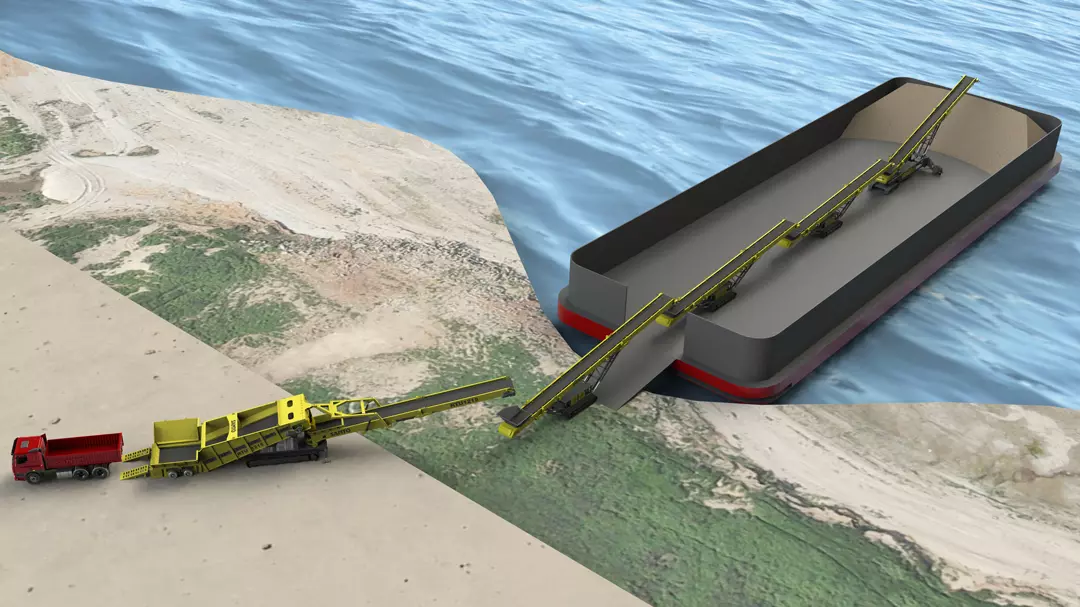
Radial truck unloader type ship loading conveyor system diagram
Can Your Truck Receiving System Keep Up with the Shiploader?
Your receiving system can keep up only if it supplies enough material over each complete truck cycle. A radial truck unloader can connect direct truck intake with onward conveying.
For example, one lane receiving a 30-tonne truck every 4 minutes supplies a theoretical 450 t/h, so it cannot continuously feed a shiploader operating at 600 t/h.
The cycle must include positioning, tipping and departure, not just the time when material leaves the truck.
How Do Bulk Density and Material Properties Affect Conveyor Selection?
Bulk density determines how much material volume the conveyor must carry to achieve a specified mass flow. At 600 t/h, a material with an assumed bulk density of 0.75 t/m³ requires 800 m³/h, while a material at 1.50 t/m³ requires 400 m³/h.
This is the detailed calculation process: Volumetric flow (m³/h) = Mass flow (t/h) ÷ Bulk density (t/m³)
For a 600 t/h requirement:
| Assumed bulk density | Required volumetric flow |
|---|---|
| 0.25 t/m³ | 2,400 m³/h |
| 0.75 t/m³ | 800 m³/h |
| 1.50 t/m³ | 400 m³/h |
These densities are calculation inputs, not specifications for particular cargoes. Measure or obtain representative data for your actual material.
You must also check lump size, moisture, temperature, abrasiveness and dust characteristics. These properties influence belt selection, chute geometry, wear protection and containment.
What Is the Best Way to Feed a Ship Loading Conveyor?
Match the receiving equipment to the material source: use a truck unloader for direct truck deliveries, a hopper feeder for wheel-loader feeding, or a controlled conveyor connection for plant and silo discharge.
The table below shows the options corresponding to different material sourcing methods:
| Material source | Possible arrangement | Main check |
|---|---|---|
| Delivery trucks | Truck unloader → transfer conveyor → shiploader | Truck cycle and surge capacity |
| Stockpile with wheel loader | Hopper feeder → transfer conveyor → shiploader | Bucket cycle and feed consistency |
| Processing plant | Plant conveyor → transfer line → shiploader | Interface capacity and controls |
| Silo or storage system | Controlled discharge → conveyor → shiploader | Flow regulation and cargo compatibility |
For loader-fed operations, a wheeled hopper stacker provides a receiving point and controlled onward feed.
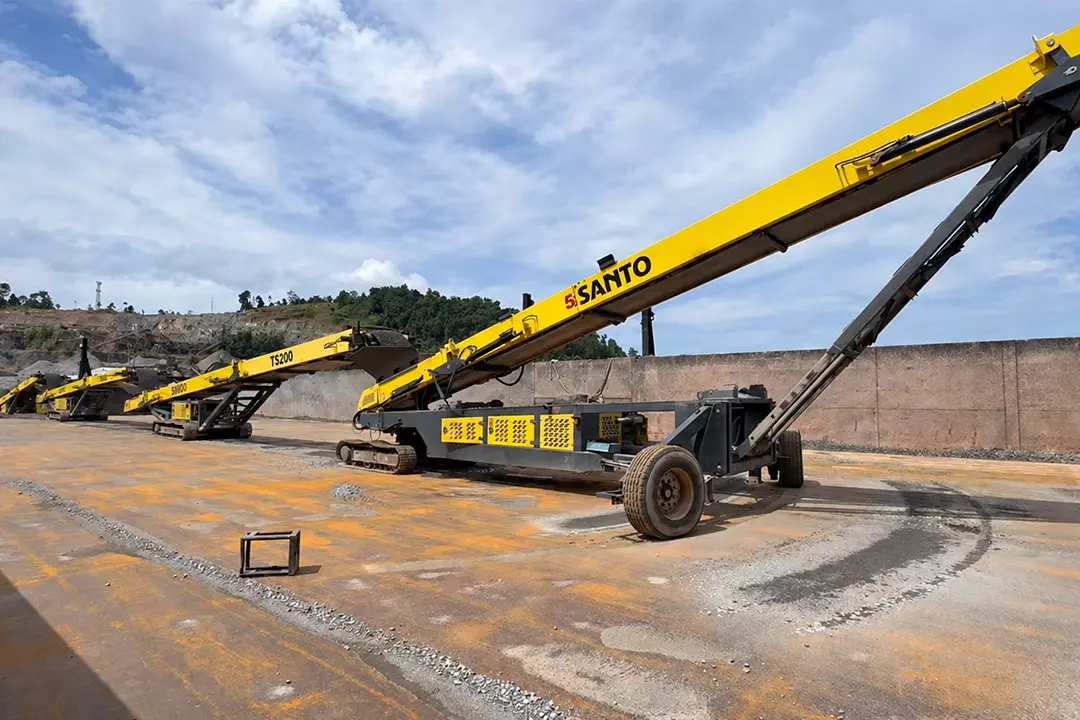
Tracked radial ship loading conveyor system
Will the Conveyor Reach Every Required Hatch Position?
The conveyor can reach the required positions only if its working range covers the hatch locations and discharge heights throughout loading. Check horizontal reach, quay setback, boom angle, water-level changes and vessel obstructions together.
For example, a simplified 42 m pivot-to-discharge boom at 20° provides approximately 39.5 m of horizontal projection. An 8 m setback leaves about 31.5 m beyond the quay edge.
When the receiving point sits farther inland, grasshopper transfer conveyors can connect sections of the route. Include each transfer point in the capacity, dust-control and maintenance assessment.
How to Reduce Dust and Spillage During Ship Loading?
Control dust and spillage at the receiving hopper, conveyor transfers, return belt and vessel discharge. Combine suitable containment, aligned chutes, belt cleaners and cargo-compatible extraction or suppression measures. As shown in table below:
| Location | Measures to evaluate |
|---|---|
| Receiving hopper | Containment, controlled tipping and suitable dust capture |
| Conveyor transfer | Chute alignment, skirt sealing and enclosure |
| Exposed belt section | Covers or enclosure suited to cargo and weather |
| Vessel discharge | Adjustable chute and controlled drop distance |
| Return belt | Belt cleaners and carryback collection |
NIOSH’s Dust Control Handbook for Industrial Minerals Mining and Processing covers dust-control approaches for conveying, transfer and loadout operations. Use it as technical background when assessing mineral cargo handling.
How to Calculate Ship Loading Conveyor Operating Cost per Ton?
Divide the total operating cost over a defined period by the tonnes loaded during that period. Include energy, labour, wear parts, maintenance, cleaning and other relevant operating expenses. (Study Case: Five-Conveyor System for Port Loading in Indonesia >>)
Example: Calculate Conveying Energy
Assume a complete loading line draws an average 150 kW while conveying 500 t/h:
Energy per tonne: 150 ÷ 500 = 0.30 kWh/t
At an assumed electricity price of US$0.12/kWh:
Electricity cost: 0.30 × 0.12 = US$0.036/t
Add idle consumption, labour, maintenance and any other energy users to calculate total operating cost.
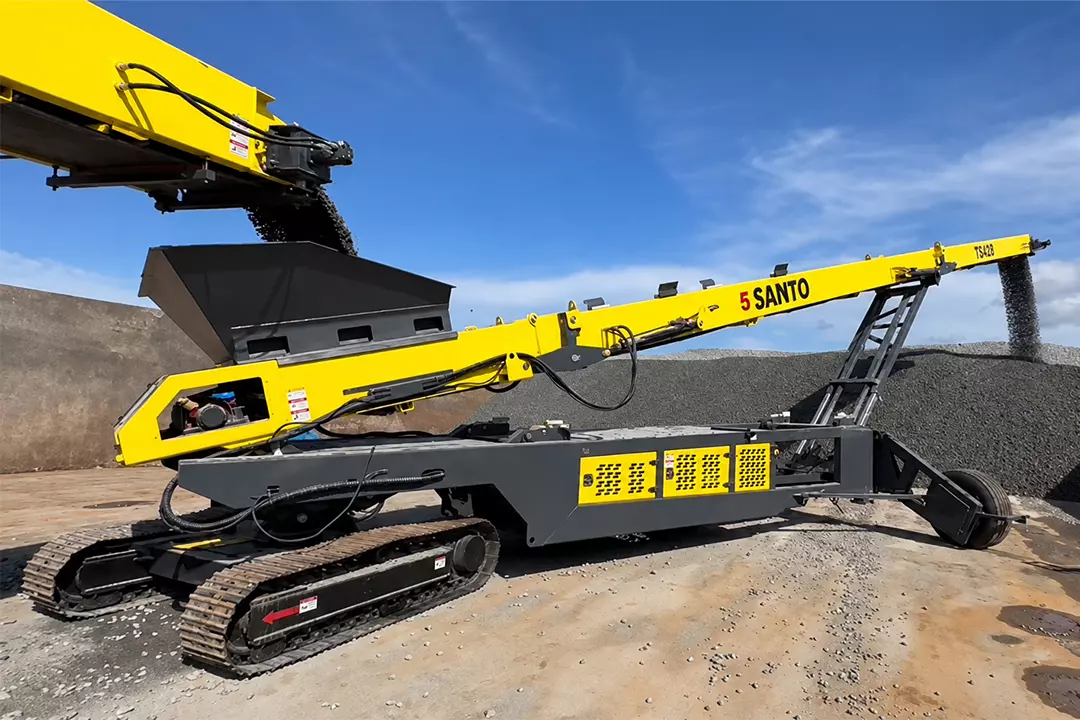
Tracked radial stockpiling conveyor for ship loading
Frequently Asked Questions
Is a mobile shiploader better than a fixed system?
Choose according to the operating layout. Mobile equipment offers relocation flexibility. A fixed installation may suit a permanent loading point with consistent cargo flow.
Can one conveyor load both ships and barges?
Yes, if its operating range covers both vessel types. Verify outreach, minimum and maximum discharge heights, hatch access and water-level changes.
Does a 700 t/h rating mean the terminal will load 700 tonnes every hour?
No. A rating describes capacity under specified conditions. Actual terminal throughput also depends on the material, receiving rate, interruptions and vessel loading sequence.
Does a longer boom always provide better coverage?
No. Boom angle, pivot position, retraction limits and quay setback affect usable coverage. Confirm near-hatch access as well as maximum reach.
Can a stockpiling conveyor serve as a shiploader?
Yes, confirm structural suitability, reach, discharge equipment, marine protection, controls and berth compatibility before selecting the machine.
Inquire About Your Ship Loading Conveyor Now
Provide these details when requesting a proposal:
- Material properties and representative test data.
- Cargo quantity and available loading window.
- Required running rate and expected interruptions.
- Truck, loader or upstream conveyor feeding method.
- Vessel dimensions and hatch drawings.
- Berth layout, quay capacity and permitted equipment positions.
- Water levels, weather conditions and site power supply.
- Dust-control, cargo-quality and operating requirements.
These inputs allow the supplier to assess the entire loading route and identify capacity or geometry constraints early.
Contact SANTO with your material data, vessel drawings and berth layout to discuss a suitable ship loading conveyor configuration.
External References:
- Telestack: Radial Telescopic Shiploaders
- Superior Industries: Mobile Ship Loading Conveyors
- International Maritime Organization: BLU Code and BLU Manual
- CDC/NIOSH: Dust Control Handbook for Industrial Minerals Mining and Processing
- OSHA: Grain Handling
- Conveyor Equipment Manufacturers Association: Conveyor Safety Resources