


How to Calculate Belt Conveyor Capacity?
- Updated 2026-11-12
- Source:
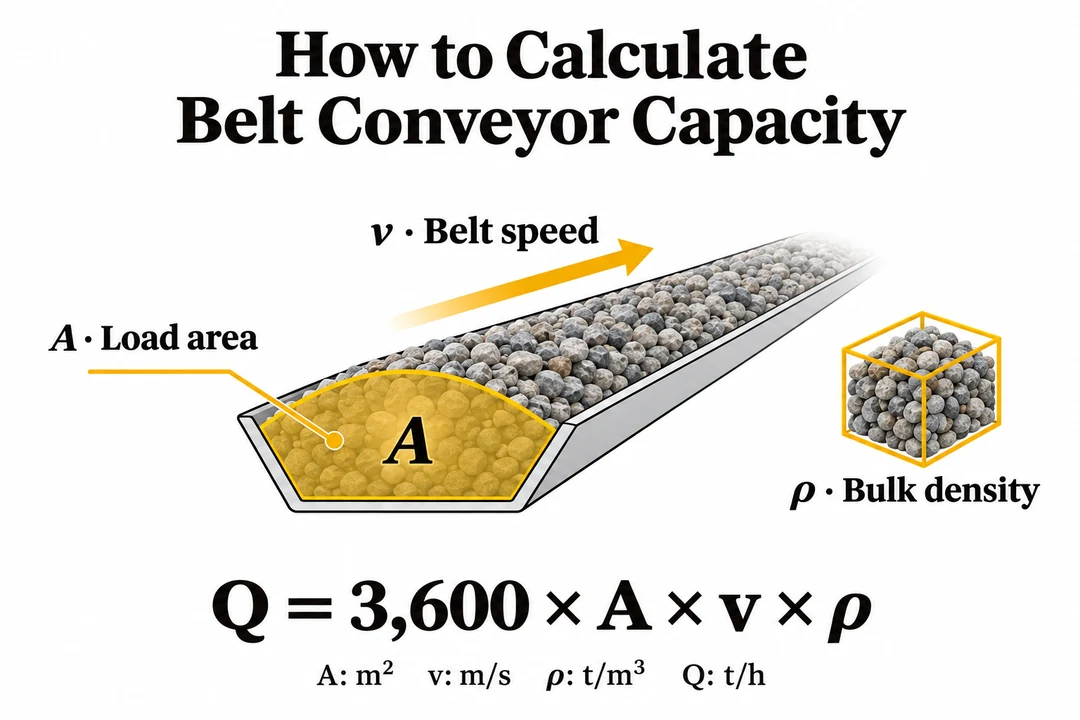
To calculate belt conveyor capacity in metric tonnes per hour, multiply the loaded cross-sectional area by belt speed, bulk density and 3,600:
Capacity (t/h) = 3,600 × Load area (m²) × Belt speed (m/s) × Bulk density (t/m³)
The calculation tells you how much material the belt can carry under the conditions you enter. Reliable results depend on accurate inputs.
Whether you need to check an existing installation or compare mobile conveyors and stackers, start with the material and required throughput. Then check whether the conveyor’s loading arrangement, drive and discharge system can support that duty.
This article includes materials such as sand, gravel, crushed stone and ore. Throughout the article, t/h means metric tonnes per hour.
Belt conveyor capacity calculation formula
What Is the Belt Conveyor Capacity Calculation Formula?
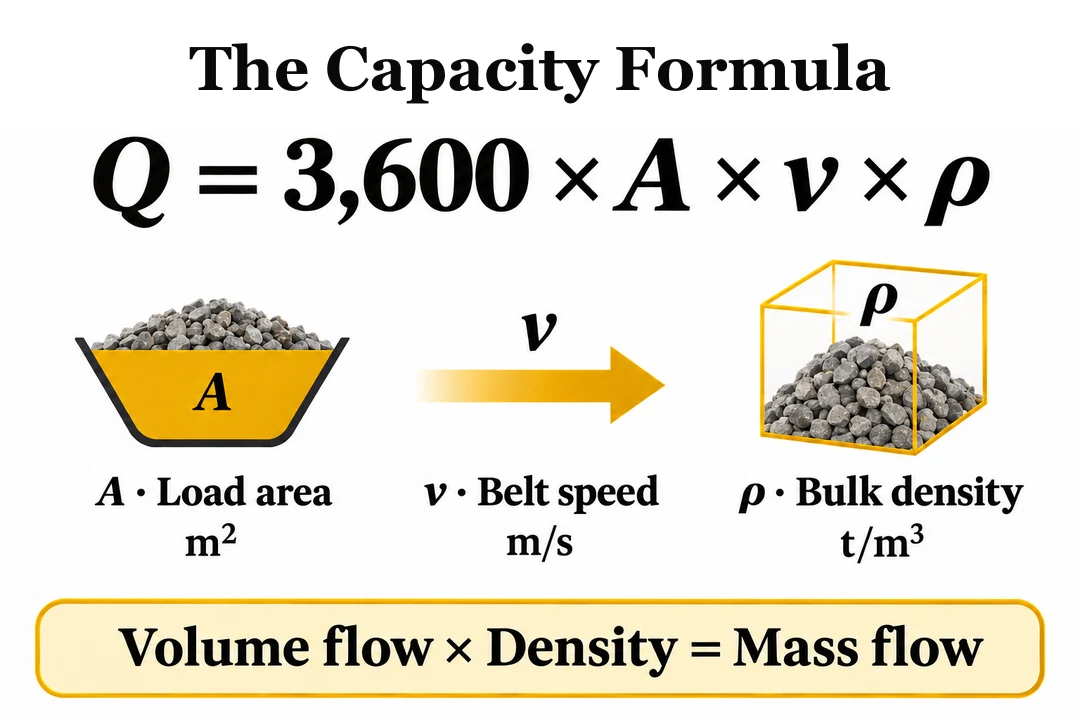
The belt conveyor capacity calculation formula is Qm = 3,600 × A × v × ρ when bulk density uses t/m³. Calculate volumetric flow first if you need a result in cubic metres per hour.
| Symbol | Meaning | Unit |
|---|---|---|
| Qm | Mass flow rate | t/h |
| Qv | Volumetric flow rate | m³/h |
| A | Loaded material cross-sectional area | m² |
| v | Belt speed | m/s |
| ρ | Material bulk density | t/m³ |
The two calculations are:
Qv = 3,600 × A × v
Qm = Qv × ρ
The factor 3,600 converts seconds into hours. Multiplying area by speed gives the volume that passes a point each second; multiplying that volume by bulk density gives mass flow.
If your density value uses kg/m³, use:
Qm = 3.6 × A × v × ρ
Here, 3.6 combines the conversion from seconds to hours with the conversion from kilograms to metric tonnes. The area A represents the material profile across the belts, perpendicular to its direction of travel. It does not mean belt width multiplied by conveyor length.
Belt conveyor capacity calculator
How to Use a Conveyor Capacity Calculator?
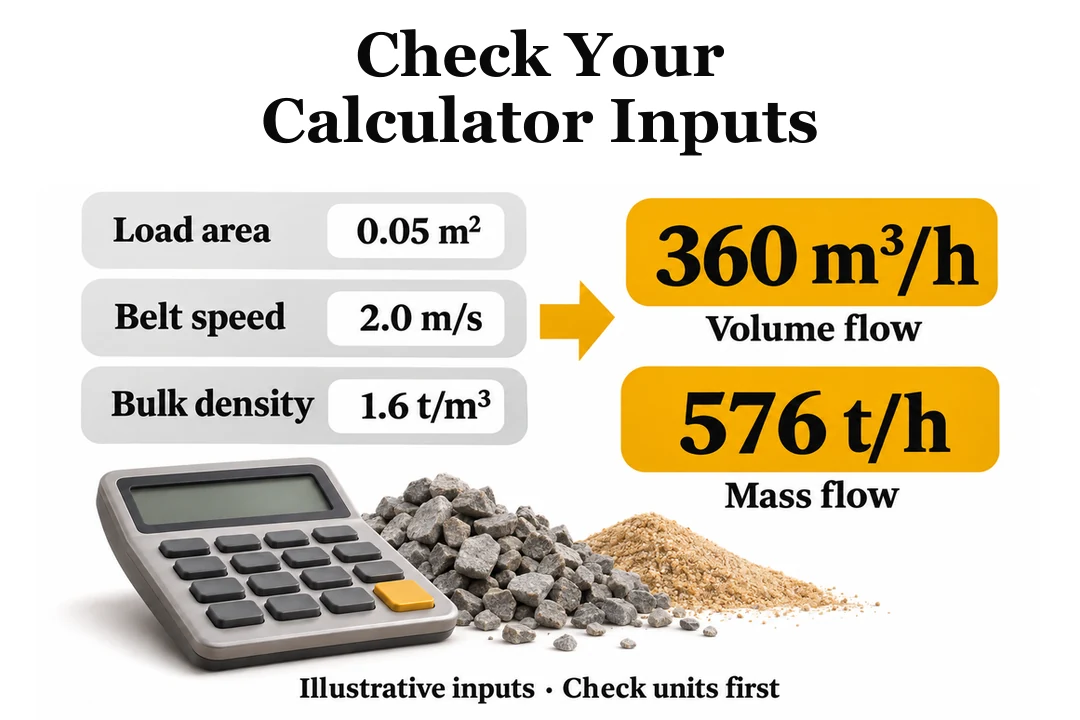
Enter the loaded cross-sectional area, belt speed and bulk density, then check the units before interpreting the result. A conveyor capacity calculator can perform the arithmetic, but it cannot correct an unsuitable load-area assumption.
For an area-based calculator, prepare these inputs:
| Input | Example | Required check |
|---|---|---|
| Loaded cross-sectional area | 0.05 m² | Use material area, not belt surface area |
| Belt speed | 2.0 m/s | Convert m/min to m/s if necessary |
| Bulk density | 1.6 t/m³ | Confirm whether the calculator expects t/m³ or kg/m³ |
These inputs give 360 m³/h and 576 t/h. They form an illustrative example, not a performance claim for a particular machine.
You can also run the same calculation in Excel or Google Sheets:
| Cell | Entry |
|---|---|
| B2 | Load area in m² |
| B3 | Belt speed in m/s |
| B4 | Bulk density in t/m³ |
| B5 | =3600*B2*B3 |
| B6 | =B5*B4 |
Cell B5 returns m³/h; cell B6 returns t/h.
If a calculator estimates area from belt width, check its assumptions about trough geometry, surcharge angle and edge clearance. Two calculators can return different answers for the same belt width because they assume different material profiles.
Treat a calculator result as a flow estimate under stated conditions. It does not establish motor power, belt tension or structural suitability.
Information required to calculate conveyor capacity
What Information Do You Need Before Calculating Capacity?
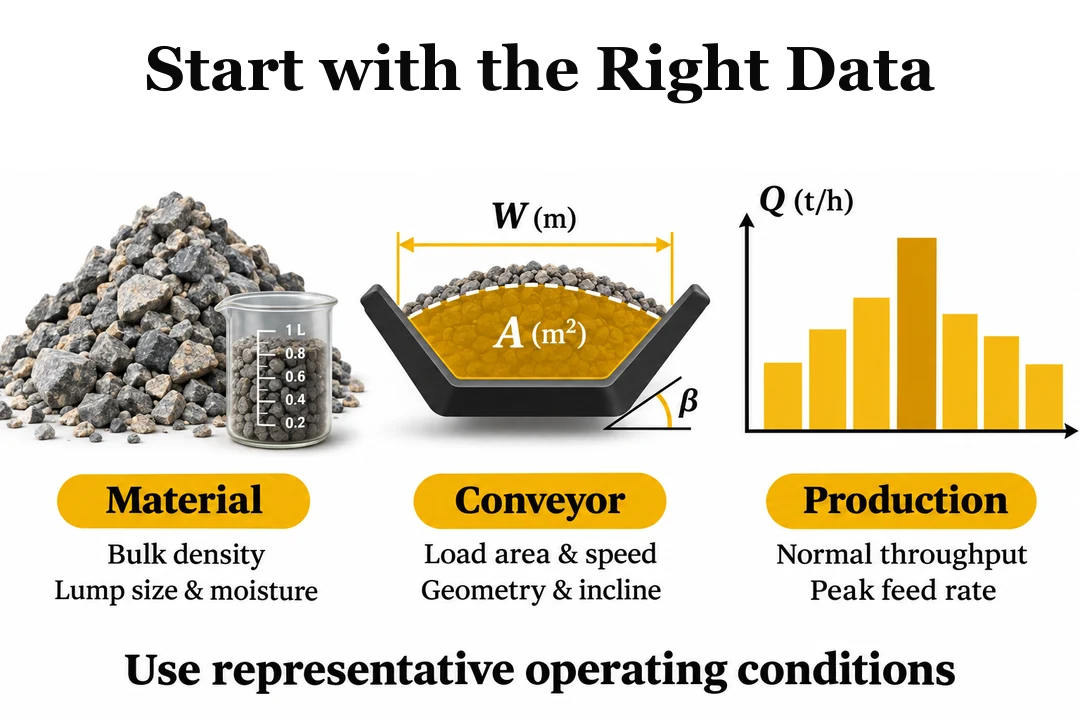
You need load area, belt speed and bulk density for the basic calculation. To use the result for equipment selection, also collect material characteristics, conveyor geometry and normal and peak feed rates.
Material properties
Record the material name, bulk density, maximum lump size, moisture content and flow characteristics.
Use bulk density, which includes the spaces between particles. Particle density describes the solid particles themselves and does not represent the mass that occupies a given volume on a conveyor.
Material names alone do not establish a reliable density. For example, Martin Engineering’s Foundations handbook reports loose bulk densities of 720–960 kg/m³ across nine coal classifications drawn from CEMA Standard 550-2003. That range illustrates why a generic “coal” setting may not match a particular feed.
Use representative project data whenever possible, and record the moisture and loading condition associated with the density value.
Conveyor geometry and speed
Collect belt width, carrying-idler arrangement, trough angle, incline angle and operating belt speed.
Motor RPM alone does not tell you belt speed. The transmission ratio and effective drive-pulley diameter also affect belt travel.
Production requirements
Record both normal and peak throughput. A steady average can hide short feed surges that overload a receiving belts or transfer chutes.
For a crushing and screening operation, follow the complete material route through the quarry and mining conveying system. Check which stream reaches each conveyor instead of assigning the plant’s total production rate to every belt.
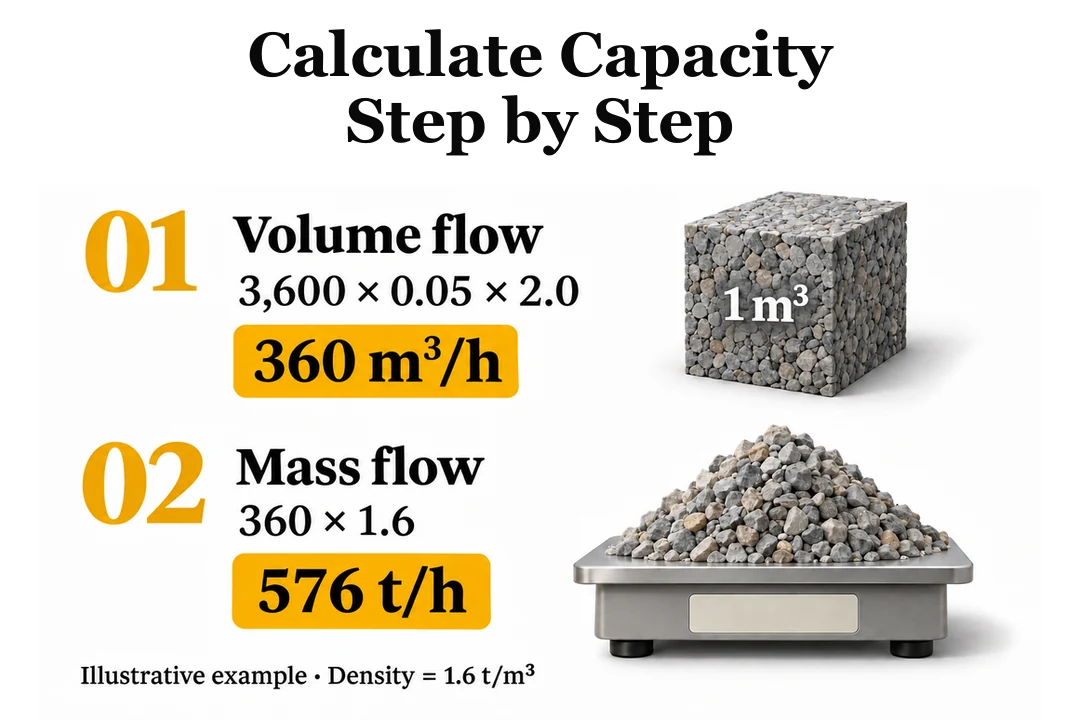
Belt conveyor capacity calculation by steps
How to Calculate Belt Conveyor Capacity Step by Step?
First calculate volumetric flow from area and speed, then multiply by bulk density to obtain mass flow. Keep units consistent throughout the calculation.
Consider a teaching example with these assumed inputs:
| Parameter | Value |
|---|---|
| Loaded cross-sectional area | 0.05 m² |
| Belt speed | 2.0 m/s |
| Bulk density | 1.6 t/m³ |
Step 1: Calculate volumetric flow
Qv = 3,600 × 0.05 × 2.0 = 360 m³/h
At this load area and speed, the belt carries 360 cubic metres per hour.
Step 2: Convert volume to mass
Qm = 360 × 1.6 = 576 t/h
The calculated mass flow equals 576 metric tonnes per hour.
Step 3: Cross-check the density units
The same density equals 1,600 kg/m³. Using the kilogram-based formula:
Qm = 3.6 × 0.05 × 2.0 × 1,600 = 576 t/h
Both methods must produce the same result.
Step 4: Test how the assumptions affect the result
| Scenario | Area | Speed | Bulk density | Calculated flow |
|---|---|---|---|---|
| Base example | 0.05 m² | 2.0 m/s | 1.6 t/m³ | 576 t/h |
| Lower speed | 0.05 m² | 1.5 m/s | 1.6 t/m³ | 432 t/h |
| Lower density | 0.05 m² | 2.0 m/s | 1.2 t/m³ | 432 t/h |
These comparisons hold the other inputs constant. In practice, changing speed can also change the loading profile, transfer behaviour and material stability.
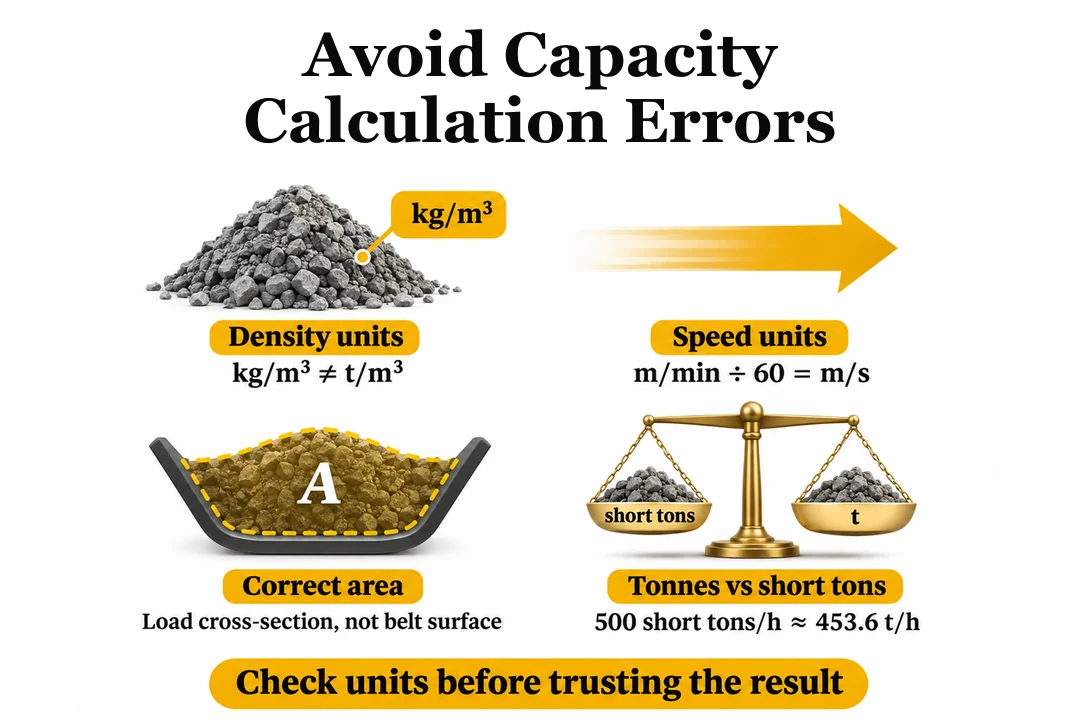
Calculate conveyor capacity unit mistakes
What Common Mistakes Affect Conveyor Capacity Calculations?
Unit errors, unsuitable load-area assumptions and confusion between calculated flow and operating performance cause many misleading results. Check these points before using a belt conveyor capacity calculation for purchasing or production planning.
| Common mistake | Correct approach |
|---|---|
| Using kg/m³ with the factor 3,600 and reporting t/h | Use 3.6 when density uses kg/m³ |
| Entering m/min as m/s | Divide m/min by 60 |
| Entering mm² as m² | Divide mm² by 1,000,000 |
| Multiplying belt width by conveyor length to obtain A | Use the material’s transverse cross-sectional area |
| Using particle density | Use representative bulk density |
| Treating repose and surcharge angles as identical | Select the appropriate moving-load profile |
| Applying the same reduction twice | Check what the original area or table already includes |
| Treating normal feed as peak feed | Record both conditions |
| Treating catalogue capacity as measured output | Confirm the rating conditions and verify site performance |
Also check what TPH means in the document you use. Suppliers may use the abbreviation for metric tonnes or US short tons.
The U.S. Energy Information Administration gives a conversion factor of 0.9071847 from short tons to metric tonnes. Therefore, 500 short tons per hour equals approximately 453.6 metric tonnes per hour, not 500 t/h.
Zhengzhou Santo Machine Co., Ltd. is one of China’s leading suppliers of mobile conveying systems. Focus on the research and development, production and sales of bulk material handling equipment. Feel free to contact us for customized solutions and machines!
External References: