

Wood Chip Conveyor for Forestry & Biomass Handling | SANTO
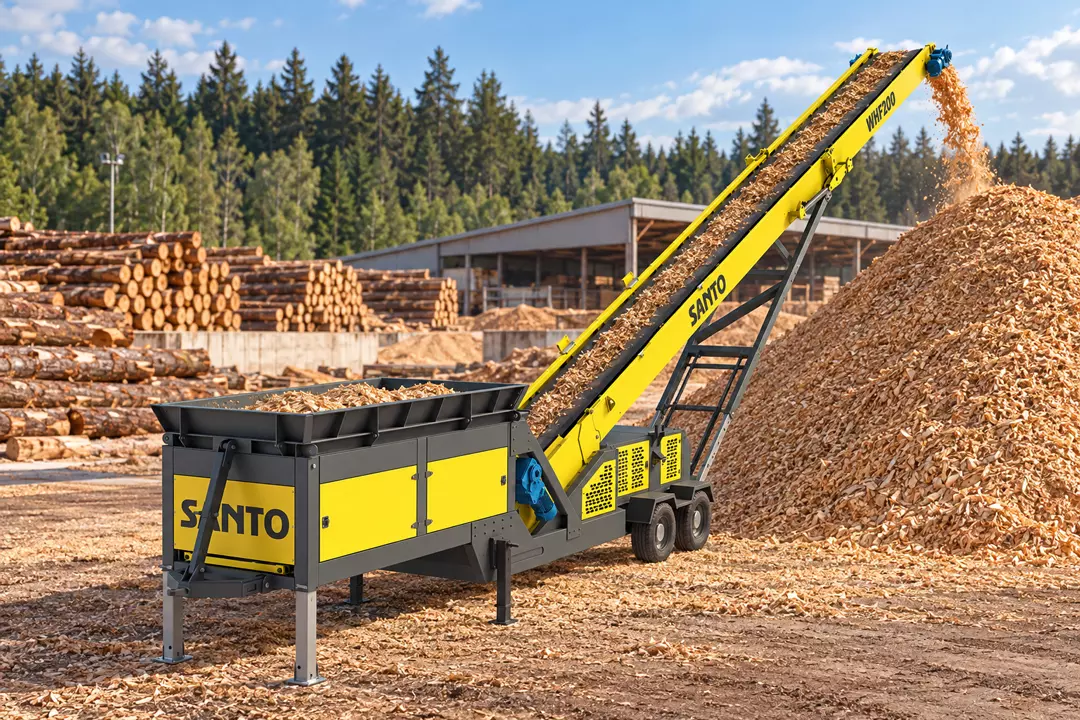
A wood chip conveyor moves bulk chips between receiving points, processing equipment and storage areas. SANTO mobile conveyors support hopper feeding, material transfer and stockpiling at wood processing sites. Each arrangement connects a specific material source with its next destination according to chip characteristics, throughput and site layout.
Start with the condition of the chips that will enter the machine. Moisture, loose bulk density, particle shape and oversized pieces can change the handling requirements.
SANTO offers mobile feeders, tracked conveyors and radial stackers for assessment against these conditions. Match each machine to the material and the handling task, then coordinate the complete route.
Match the Conveyor to Your Wood Material
Distinguish Wood Chips from Logs, Bark and Sawdust
The term “wood conveyor” covers several different applications. A conveyor that handles loose chips does not automatically suit whole logs, long branches or fine sawdust.
Identify the material at the proposed intake point and describe its condition.
| Material | Main handling considerations | Information to provide |
|---|---|---|
| Screened wood chips | Particle consistency and oversized pieces | Size distribution and maximum dimensions |
| Fresh wood chips | Moisture, density and flow behavior | Moisture content and loose bulk density |
| Processed bark | Long strips, fibres and irregular flow | Photographs, dimensions and discharge observations |
| Sawdust and fine wood residues | Dust release and containment | Fine-particle content and dust-control requirements |
| Recovered wood chips | Metal, stones and other contaminants | Material source and upstream separation details |
| Logs and unprocessed branches | Length, support and feeding method | Dimensions and required processing route |
These categories define questions for equipment selection. They do not confirm compatibility with every standard model.
Check Chip Shape, Oversize and Long Fibres
Provide maximum chip length, width and thickness in millimetres. Report long slivers and strips of bark separately from the average particle size.
Forest Research highlights the importance of chip consistency and notes that excessive fines and long slivers can cause problems in fuel-feed mechanisms. This reinforces the need to assess the receiving equipment as well as the conveyor.
Use representative photographs and samples where practical. Include wet batches and oversized pieces that the system may encounter during normal operation.
Configure the Receiving and Transfer Route
Receive Chips from a Wheel Loader
A loader-fed arrangement can connect a chip storage area with a transfer route or stockpile:
Wheel Loader → Hopper Feeder → Transfer Conveyor or Stockpile
The loader fills the hopper. The feeder supplies the next handling stage.
The SANTO Feeder Track Stacker provides one option for this arrangement. Check bucket clearance, loading height, hopper access and discharge reach before choosing the configuration.
Include the loader’s delivery cycle in the assessment. A conveyor cannot maintain continuous flow if the hopper repeatedly runs empty.
An integrated feeder stacker may complete the route on its own. Add a separate transfer conveyor when the distance or receiving position requires another stage.
Connect to a Chipper or Screen Discharge
A suitable process connection may follow this route:
Chipper or Screen Discharge → Mobile Conveyor → Storage Area
Confirm how the upstream machine releases material. A controlled gravity discharge differs from a chipper that throws chips at high speed or uses an air stream.
Engineers must assess the receiving arrangement, material trajectory and peak output. Do not assume that placing an open conveyor beneath any chipper outlet creates a suitable connection.
Transfer Stored Chips to an Existing Receiving System
For loader-assisted reclaiming, use:
Wood Chip Stockpile → Wheel Loader → Hopper Feeder → Existing Receiving Conveyor
The loader retrieves the chips; the hopper and conveyors receive and transfer them.
Telestack documents a woodchip installation that combines hopper feeders, tracked conveyors and a radial telescopic conveyor for reclaiming and stockpiling. The project illustrates this equipment arrangement, rather than a SANTO performance result.
Size the System Around Volume, Moisture and Operating Time
Calculate Required Operating Throughput
Calculate the required flow from the daily material quantity and the time available for active conveying.
The following example uses illustrative planning assumptions, not measured SANTO operating results. All tonnages refer to metric tonnes.
| Planning input | Assumed value |
|---|---|
| Daily chip handling requirement, as received | 480 t |
| Scheduled operating window | 8 h |
| Active conveying share | 80% |
| Effective conveying time | 6.4 h |
| Required average throughput during active conveying | 75 t/h |
Effective conveying time = 8 × 0.80 = 6.4 h
Required operating throughput = 480 ÷ 6.4 = 75 t/h
A route that averages 60 t/h during those 6.4 hours moves 384 t, leaving a 96 t daily shortfall.
Use the calculation to establish the operating requirement. Then check peak feed, material variation and downstream capacity.
Convert Tonnes into Loose Cubic Metres
Wood chip handling also requires a volume-flow check. Loose chips occupy substantially more space than the same mass of solid wood.
Forest Research gives an approximate range of 200–400 kg per loose m³ for chips produced from small roundwood or mixed brash. Treat this as background guidance and measure your actual material for equipment selection.
For the planning example, assume a loose bulk density of 0.25 t/m³:
Required volume flow = 75 ÷ 0.25 = 300 m³/h
At the same 300 m³/h, a different material batch with an assumed density of 0.40 t/m³ would create a mass flow of:
300 × 0.40 = 120 t/h
The volume remains unchanged, but the mass flow rises by 60%. Check both the carrying volume and the load on the conveyor.
State the Moisture Measurement Basis
Specify whether moisture content uses a wet basis or dry basis. Also state whether throughput refers to as-received mass or dry matter.
For example, 1 t of chips at 40% moisture on a wet basis contains:
- 0.40 t of water
- 0.60 t of dry matter
If the illustrative 75 t/h stream had that moisture content, it would carry 45 t/h of dry matter and 30 t/h of water.
These figures explain the calculation basis. They do not establish a standard moisture content for wood chips.
Select Mobile Equipment for Each Handling Stage
Hopper Feeders for Controlled Reception
Match hopper geometry and receiving height to the loading equipment. Check whether the actual chips flow consistently through the receiving arrangement.
Long fibres, irregular pieces or cohesive material may require additional assessment. Confirm any necessary flow-assistance features in the equipment specification rather than assuming every feeder includes them.
Tracked Conveyors for Transfer and Stockpiling
A SANTO Tracked Stacking Conveyor offers a mobile option for transferring suitable chips or placing them in a storage area.
Plan the working position around the upstream outlet and required discharge location. Leave space for repositioning and maintenance.
The following published SANTO dimensions provide starting points for layout discussions:
| Model | Equipment type | Belt width | Conveyor length | Listed stacking height |
|---|---|---|---|---|
| FTS1015 | Feeder Track Stacker | 1,000 mm | 15 m | 7.0 m |
| TS1020 | Tracked Stacker | 1,000 mm | 20 m | 8.6 m |
| TS1024R | Tracked Radial Stacker | 1,000 mm | 24 m | 10.7 m |
These figures describe reference equipment dimensions. Confirm material suitability, installed geometry and operating capacity for your project.
Do not apply a general product tonnage rating directly to wood chips. The actual chip volume, loading profile and operating conditions determine the required configuration.
Radial Stackers for Material Distribution
A radial stacker changes its discharge position across an operating arc. This allows operators to distribute material within an assigned storage area.
Check the movement envelope, support conditions and available clearance. The stockpile and nearby vehicle routes must leave sufficient room for the machine to operate.
Plan Wood Chip Stockpiles Around Quality and Access
Separate Batches by Source and Material Condition
Assign storage areas according to the distinctions your operation needs, such as source, chip size or moisture condition.
Record arrival dates and plan how loaders will retrieve each batch. Repeatedly placing new chips over older material can make stock rotation difficult.
The SANTO Tracked Radial Stacker Conveyor can support material placement within a planned storage area. Batch identification and retrieval procedures remain part of the site’s operating system.
Consider Drainage, Storage Time and Inspection
Assess how rainwater, ground contact, airflow and storage duration may affect the chips.
Forest Research explains that air does not move easily through chip heaps and that biological activity can generate heat. These conditions make storage management important alongside conveyor selection.
Develop a storage and inspection plan appropriate to the material and facility. A stacking conveyor does not automatically dry chips or control pile temperature.
The TS1024R’s 10.7 m listed stacking height describes an equipment capability. It does not establish a suitable pile height for every wood material or storage period.
Connect the Conveyor to Your Wood Processing Site
Measure Each Receiving and Discharge Interface
Provide a dimensioned layout that shows the complete route.
| Interface | Information to confirm |
|---|---|
| Upstream discharge | Release method, position, width and height |
| Downstream inlet | Opening dimensions and acceptable flow |
| Transfer route | Horizontal distance and elevation difference in m |
| Material conditions | Loose bulk density, moisture and chip dimensions |
| Working area | Movement envelope, traffic routes and overhead clearance |
| Electrical supply | Voltage, frequency and available power |
| Controls | Operating sequences, stop signals and fault responses |
For suitable material and geometry, a SANTO Transfer Conveyor may provide a transfer link. The current range lists conveyor lengths from 20 m to 35 m.
Conveyor length does not equal the clear gap between two machines. Inclination, receiving overlap and discharge geometry affect the installed arrangement.
Coordinate Feed with Downstream Equipment
Agree on how the route responds when the receiving equipment stops or cannot accept more chips.
Distinguish yard transfer from process dosing. Supplying a biomass receiving conveyor does not automatically provide the precise metering and control that a boiler or other process requires.
Wood chip systems may use belt, screw, drag or other conveying technologies according to the duty. Materials Handling Equipment’s product overview illustrates this range of equipment types.
Manage Spillage, Wood Dust and Maintenance
Review Material Loss at Transfer Points
Inspect the planned receiving and discharge points for chip scattering, fine-material escape and accumulation.
Assess chute geometry, sealing, belt cleaning and containment according to the actual material. Confirm the components in the supply scope and leave access for inspection.
Keep the surrounding work area accessible as piles grow. Material buildup should not obstruct equipment access or planned vehicle routes.
Assess Dust and Fire Protection Requirements
Fine wood dust can present fire and explosion hazards under suitable conditions. HSE’s woodworking guidance identifies these risks and discusses the importance of appropriate controls.
Assess the actual dust characteristics, potential ignition sources and operating environment. Define any required extraction, monitoring or protection systems through the project’s technical review.
A mobile biomass conveyor does not automatically include every dust or fire-protection feature. Confirm the specified configuration.
Provide Access for Inspection and Cleaning
Leave practical access around rollers, pulleys, drives and transfer points. Maintenance teams should follow the facility’s isolation procedure before clearing trapped material or working near moving components.
CEMA’s safety resources support guarding, training and safe operating practices alongside site-specific assessments.
What Determines the Cost of a Wood Chip Conveyor?
A useful quotation starts with a defined material stream and handling route.
Key cost factors include:
- Chip dimensions, moisture and loose bulk density.
- Required mass flow in t/h and volume flow in m³/h.
- Feeding method, transfer distance and discharge height.
- Number of machines and mobility requirements.
- Cleaning, containment and control interfaces.
- Transport, installation and site works.
Compare proposals against the same material conditions and scope of supply. Include loading equipment, cleaning time, wear parts and maintenance when reviewing operating costs.
Avoid selecting a system solely by its advertised tonnage. Confirm that the proposed equipment can meet your actual chip-handling requirements.
Wood Chip Conveyor FAQs
What Type of Conveyor Can Handle Wood Chips?
Belt, screw, drag and other conveyors can serve different wood chip applications.
Can the Same Conveyor Handle Wet and Dry Wood Chips?
Yes, but moisture changes can accompany differences in density, adhesion and flow behavior.
How Do You Calculate Wood Chip Conveyor Capacity?
Calculate the required mass flow from daily tonnage and effective operating hours, then divide by loose bulk density. For example, 480 t ÷ 6.4 h = 75 t/h. At an assumed 0.25 t/m³, the required volume flow equals 300 m³/h.
Can a Wood Chip Conveyor Also Handle Logs or Sawdust?
No, logs require different support and feeding arrangements; sawdust introduces fine-material and dust-control considerations.
Can a Mobile Conveyor Feed an Existing Biomass Receiving System?
Yes, when material characteristics, receiving geometry, throughput and controls match.
Request a Wood Chip Handling Layout
Share the following details so SANTO can assess your feeding, transfer and stockpiling requirements:
- Wood material type and source.
- Chip dimensions, fines and oversized pieces.
- Loose bulk density and moisture content, including measurement basis.
- Required throughput and operating hours.
- Loading method and upstream discharge details.
- Transfer distance, receiving height and storage layout.
- Power supply, site drawings and material photographs.
Contact SANTO to discuss a wood chip conveyor configuration. Provide your chip specifications and site layout to identify suitable equipment and the connections your operation needs.
External References