

Mobile Stacking Conveyor for Construction Waste | SANTO
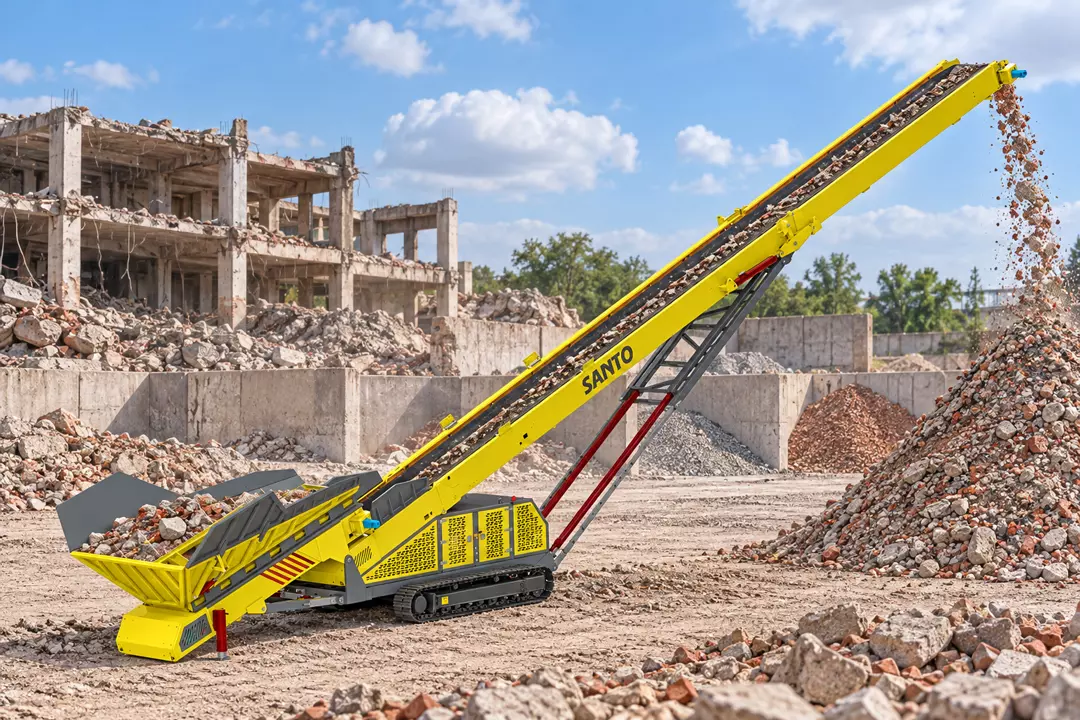
A construction waste conveyor moves suitable demolition materials between receiving points, processing equipment and stockpiles. SANTO mobile conveyors support feeding, transfer and stacking around crushers, screens and storage areas. Each arrangement matches the material condition, required throughput and available working space.
Crushed concrete, brick fragments and screened mineral materials can require different loading and transfer arrangements. Check their size, shape, moisture and remaining contaminants before choosing equipment.
SANTO offers mobile feeders, tracked conveyors and radial stackers for these handling tasks. Start with the material that will enter the machine, then plan its route through your site.
Identify the Material Before Choosing a Rubble Conveyor
Separate Raw Demolition Debris from Processed Material
Describe the material at the proposed conveyor intake. A pile of untreated demolition debris differs significantly from the output of a crusher or screen.
Raw debris may contain large concrete sections, timber, plastic, metal and other building components. Processing changes the size and composition of that stream.
| Material condition | Main selection questions |
|---|---|
| Crushed concrete | What is the maximum lump size? Does protruding rebar remain? |
| Crushed brick and masonry | How much fine material does the stream contain? |
| Screened mineral fractions | What are the particle size range, moisture content and bulk density? |
| Mixed rubble | Which non-mineral materials and contaminants remain? |
| Unprocessed demolition debris | What sorting, size reduction or specialized reception does the material require? |
Use photographs, size measurements and representative samples to support the assessment. Include difficult material conditions rather than only clean, uniform output.
Check Lump Size, Shape and Residual Metal
Measure maximum piece dimensions in millimetres. Record elongated fragments and protruding steel separately from the general particle size distribution.
Belt width alone does not establish the maximum acceptable lump size. Engineers also need to assess loading impact, belt support, hopper geometry and transfer clearances.
Confirm the required upstream preparation before conveying. A standard rubble conveyor transports material; it does not automatically break oversized concrete or remove steel.
Connect Crushing, Screening and Stockpiling Operations
Receive Material from a Mobile Crusher
A common arrangement moves processed material away from the crusher discharge:
Mobile Crusher Discharge → Tracked Conveyor → Stockpile
The conveyor receives the crusher output and carries it to a designated storage area. Check the discharge height, material trajectory and peak flow before positioning the receiving end.
A SANTO Crawler Stacker provides one option for this task. Match its receiving arrangement to the crusher rather than choosing solely by conveyor length.
Tracked conveyor applications commonly include stockpiling after mobile crushing and screening equipment. Telestack also identifies construction and demolition waste among its tracked conveyor applications.
Build Separate Stockpiles from Screen Outputs
A screening operation may send different material fractions to separate destinations:
Screen Outlet → Dedicated Conveyor → Designated Aggregate Stockpile
Align each receiving conveyor with the corresponding screen outlet. Check both the expected flow and changes in the fraction split as incoming material varies.
Maintain separation through the entire route. Overlapping discharge areas or poorly planned loader movements can mix fractions after screening.
Feed Suitable Stored Material with a Loader
For material that already meets the receiving requirements, consider:
Wheel Loader → Hopper Feeder → Transfer or Stockpiling Conveyor
The loader collects material, the hopper receives it, and the feeder supplies the conveying route.
Confirm material suitability before using this arrangement. Large untreated demolition pieces may require additional preparation or a different receiving system.
Calculate Capacity from the Actual Material Flow
Allow for Effective Operating Hours
Calculate the required operating throughput from the material quantity and the time available for active conveying.
The following example uses illustrative planning assumptions, not measured SANTO performance. All tonnages refer to metric tonnes.
| Planning input | Assumed value |
|---|---|
| Daily processed-material transfer requirement | 1,200 t |
| Scheduled operating window | 8 h |
| Active conveying share | 75% |
| Effective conveying time | 6 h |
| Required average throughput during active conveying | 200 t/h |
Effective conveying time = 8 × 0.75 = 6 h
Required operating throughput = 1,200 ÷ 6 = 200 t/h
At an average of 150 t/h over the same 6 hours, the route would move 900 t, leaving a 300 t shortfall.
Include realistic allowances for feed interruptions, inspections and equipment repositioning. Then assess peak flow, bulk density and loading conditions before selecting a machine.
Size Each Screen Discharge Route Separately
The total screen throughput does not necessarily pass through every discharge conveyor.
For an illustrative 200 t/h screen feed, assume two outlets receive 60% and 40% of the incoming mass:
| Outlet | Assumed mass share | Average flow |
|---|---|---|
| A | 60% | 120 t/h |
| B | 40% | 80 t/h |
| Total | 100% | 200 t/h |
These figures describe an assumed steady operating condition. Changes in feed grading can shift the split.
Check the highest expected flow at each outlet. Do not size both conveyors around an equal 100 t/h share unless operating data supports that assumption.
Select Equipment Around Feeding Height and Discharge Reach
Low Feed Hoppers for Loader Reception
Match the hopper to the loading machine and its approach route. Check bucket width, dumping clearance, loading impact and room for vehicle movements.
The SANTO Low Feeder Track Stacker provides a low receiving arrangement for assessment. Its suitability depends on the actual material and loading conditions.
Also compare the loader’s delivery cycle with the feeder’s output. Repeated gaps between loads can limit the route even when the conveyor has sufficient nominal capacity.
Tracked Conveyors for Relocatable Processing Setups
Tracked conveyors allow operators to reposition equipment as the working area changes. Plan the travel route and confirm ground conditions before moving the installation.
The following SANTO reference dimensions help establish initial layout requirements:
| Model | Equipment type | Belt width | Conveyor length | Listed stacking height |
|---|---|---|---|---|
| TS820 | Tracked Stacker | 800 mm | 20 m | 8.6 m |
| LTS1020 | Low Feeder Track Stacker | 1,000 mm | 20 m | 8.3 m |
| TS1024R | Tracked Radial Stacker | 1,000 mm | 24 m | 10.7 m |
These figures describe published product dimensions. Confirm the final configuration, material suitability and operating capacity for your project.
Radial Stackers for Wider Stockpile Distribution
A radial stacker changes the discharge position across an operating arc. This can help distribute material within an assigned storage area.
Allow room for the machine’s movement, support arrangement and growing stockpile. Check that the operating area remains clear of vehicle routes and adjacent equipment.
Plan the Conveyor Layout Around a Changing Worksite
Measure the Complete Transfer Route
A useful site drawing shows more than the distance between two machines. Include the receiving point, discharge destination, ground conditions and access requirements.
| Layout item | Information to provide |
|---|---|
| Upstream equipment | Discharge width, height and position |
| Transfer route | Horizontal distance and elevation difference in m |
| Storage area | Available length, width and overhead clearance |
| Ground conditions | Slope, bearing conditions and support locations |
| Traffic routes | Loader, excavator and truck movements |
| Electrical supply | Voltage, frequency and available power |
| Maintenance space | Access around belts, drives and transfer points |
For a suitable longer transfer route, assess a SANTO Transfer Conveyor. The current range lists lengths from 20 m to 35 m.
The JC1030, for example, lists a 30 m conveyor length and 29.7 m horizontal distance. Neither figure automatically equals the clear gap between two machines; receiving overlap and discharge geometry affect the installation.
Plan Repositioning Before the Stockpile Expands
Reserve space for the next working position before material occupies it. Check how the conveyor will disconnect, move and reconnect to the upstream equipment.
Include control interfaces in that plan. Define how upstream feeding responds if the conveyor or downstream process stops.
Terex describes its modular waste conveyors as configurable for different installations and specifically identifies construction and demolition waste applications. This supports selecting the arrangement around the site and handling duty.
Keep Recycled Aggregate Fractions Separate
Assign a Clear Destination to Each Fraction
Mark separate storage areas for the fractions your process produces. Match the discharge position to the pile boundary and leave room for loaders to collect material without crossing neighboring piles.
Use the project’s actual grading requirements when labeling stockpiles. Different customers and applications may require different material specifications.
The SANTO Crawler Radial Stacker offers an option for distributing suitable material within a designated stockpiling area.
Match Pile Geometry to Site Conditions
Equipment reach, material behavior and ground conditions all affect the pile layout.
For example, the TS1024R lists a 10.7 m stacking height. That equipment figure does not establish the permitted pile height or usable storage capacity at every site.
Conveying and stockpiling also do not certify the recovered material for reuse. EPA identifies aggregate among the uses for recycled concrete and rubble, but a project still needs appropriate material assessment and quality control for its intended application.
Address Dust, Impact and Maintenance Access
Review Dust at Receiving and Discharge Points
Assess dust wherever material enters a hopper, crosses a transfer point or falls onto a stockpile. Concrete and masonry processing can create dust containing respirable crystalline silica.
HSE’s guidance for crushing and screening demolition material recommends measures including water suppression at crushing and transfer points and minimizing drop heights. Use a site-specific assessment to select and maintain effective controls.
Confirm which dust-control components the equipment quotation includes. Do not assume every mobile conveyor carries the same suppression or containment system.
Assess Loading Impact and Belt Wear
Sharp fragments, large pieces and unsuitable loading arrangements can increase impact and wear. Review the loading direction, drop height, receiving support and transfer geometry together.
Specify any required wear protection, belt cleaning or receiving modifications during equipment selection. Use actual material information to support those decisions.
Leave Access for Inspection and Safe Isolation
Provide access to rollers, pulleys, belt cleaners and transfer points. Keep inspection areas clear as stockpiles grow.
Maintenance teams should follow the site’s isolation procedure before clearing blockages or working near moving components. CEMA’s conveyor safety resources support guarding, training and safe operating practices alongside site-specific assessments.
What Determines the Cost of a Construction Waste Conveyor?
A useful quotation starts with a defined material and handling task.
The main cost factors include:
- Maximum lump dimensions, abrasion and contaminants.
- Required continuous and peak throughput.
- Receiving method, conveyor length and discharge height.
- Number of conveying stages and mobility requirements.
- Wear protection, cleaning and dust-control arrangements.
- Electrical interfaces, transport, installation and site works.
Compare quotations against the same scope of supply. Include loader use, cleaning time, wear parts and repositioning requirements when reviewing operating costs.
A dimensioned layout and representative material photographs help suppliers recommend equipment without relying on a generic tonnage figure.
Construction Waste Conveyor FAQs
What Materials Can a Construction Waste Conveyor Handle?
The construction waste conveyor can handle concrete, brick, masonry and other mineral fractions. Confirm maximum dimensions, material shape, moisture and contaminants first.
Can a Rubble Conveyor Handle Concrete with Rebar?
Yes, but it can’t handle protruding rebar and long steel pieces. They can interfere with receiving and transfer arrangements or damage components.
Can a Demolition Conveyor Connect to a Mobile Crusher or Screen?
Yes, when the material, receiving geometry and flow requirements match. Check discharge height, outlet width, particle size and peak throughput.
How Do You Choose Conveyor Capacity for a Demolition Site?
Divide the required tonnage by effective conveying hours, then assess peak conditions. For example, 1,200 t ÷ 6 h = 200 t/h.
Is a Mobile Stacker Suitable for Confined Indoor Work?
Yes, but suitability depends on machine dimensions, access, working clearance, power and site conditions.
Request a Conveyor Layout for Your Demolition Project
Share the following information so SANTO can assess your feeding, transfer and stockpiling requirements:
- Material type and condition after processing.
- Maximum lump dimensions and residual metal.
- Required throughput and daily operating hours.
- Crusher or screen discharge details.
- Transfer distances and receiving heights.
- Ground conditions, traffic routes and storage areas.
- Power supply, site drawings and material photographs.
Contact SANTO to discuss a construction waste conveyor configuration. Provide your material details and site layout to identify suitable equipment and the connections your project requires.
External References