
Mobile Stacking Conveyor for Waste Recycling | SANTO
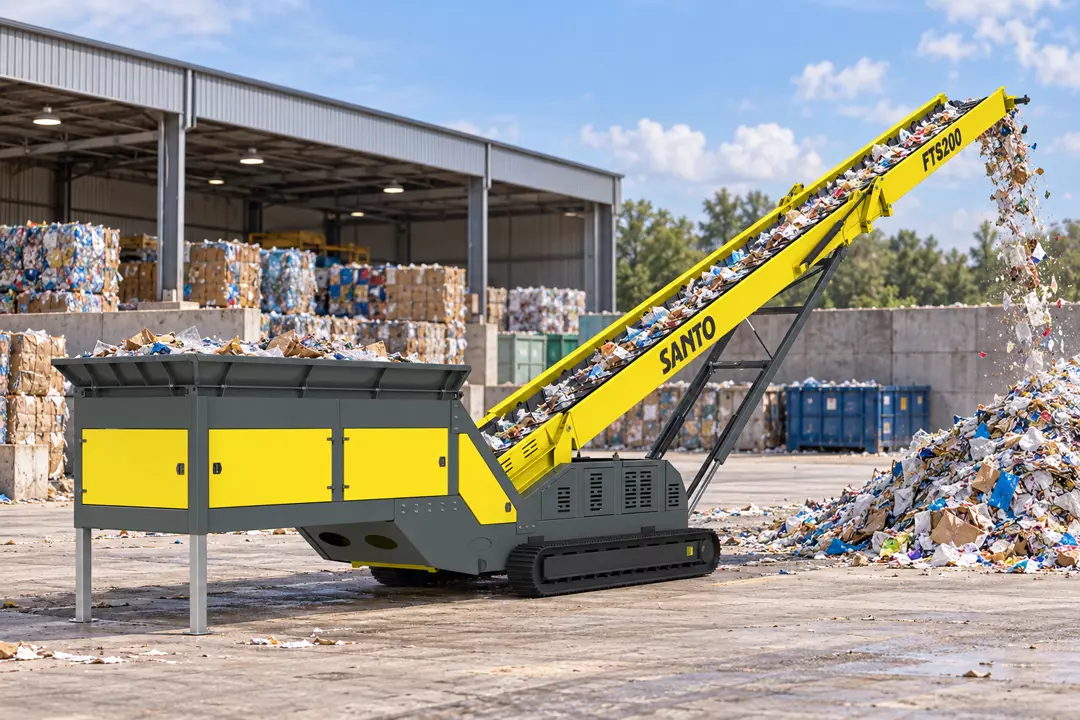
A recycling conveyor moves material between receiving areas, processing equipment and storage points. SANTO mobile conveyors support hopper feeding, transfer and stockpiling around your facility layout. They connect handling stages while your screens, shredders and separation equipment perform their specific processing tasks.
Start with the material that will enter the conveyor. Loose plastic, screened compost and recovered mineral fractions place different demands on the same handling route. Their density, shape, moisture and size influence equipment selection.
SANTO offers mobile feeders, tracked conveyors and radial stackers for assessment against these requirements. Match each machine to its receiving point, discharge destination and required material flow.
Match the Conveyor to Your Recycling Material
Identify the Material Condition at Each Handling Stage
Describe the material at the exact point where the conveyor will receive it. “Mixed waste” provides too little information for a useful equipment recommendation.
A shredder changes material size and shape. A screen separates fractions. A sorting stage removes selected components. Each operation changes what the next conveyor must handle.
| Material stream | Main handling questions | Useful information |
|---|---|---|
| Shredded mixed waste | Does the stream contain long strips, oversized pieces or sharp objects? | Size distribution, photographs and contaminant details |
| Screened compost or green waste | Does moisture cause adhesion or buildup? | Moisture content, bulk density and flow observations |
| Recovered wood fractions | Do elongated pieces affect loading and discharge? | Maximum dimensions and residual metal content |
| Loose paper and plastic fractions | How much volume must the belt carry, and how easily does material escape? | Loose bulk density, shape and containment requirements |
| Recovered mineral fractions | What impact and abrasion will the equipment experience? | Maximum lump size, density and loading method |
These categories identify conditions to assess. They do not establish universal compatibility with every standard conveyor.
Check Oversize, Tangling and Contaminants
Flag flexible strips, wire, rope and sharp metal before equipment selection. Their shape can matter as much as their weight.
Provide representative photographs and, where practical, material samples. Include difficult batches rather than only the cleanest output.
Agree on any required inspection, separation or size reduction before material reaches the conveyor. A stacking conveyor transports the incoming stream; it does not automatically remove contaminants or prepare unsuitable material.
Connect Receiving, Screening and Shredding Stages
Feed an Existing Processing Machine
A loader-fed arrangement can connect a receiving area with an existing processing stage:
Wheel Loader → Hopper Feeder → Existing Screen or Shredder
The loader fills the hopper. The feeder delivers material to the receiving machine at a rate that the process can accept.
The SANTO Low Feeder Track Stacker provides a low receiving arrangement for layout assessment. Check its hopper access, discharge position and operating range against your loading equipment and downstream inlet.
Keep the processing sequence specific to your facility. Some operations screen before shredding; others use a different sequence according to the incoming material and required output.
Transfer Processed Material to the Next Stage
A separate conveyor can connect a processing machine with the next handling point:
Shredder Discharge → Transfer Conveyor → Next Processing Stage
Measure the upstream discharge width and height. Check where material lands, how it spreads and whether the receiving conveyor can accept peak output.
Recycling equipment suppliers distinguish conveying and stockpiling from shredding, screening and separation. EDGE’s product range illustrates these separate equipment functions.
Move Screened Fractions into Separate Stockpiles
For a screen outlet, a typical arrangement is:
Screen Discharge → Mobile Stacker → Designated Material Stockpile
Give each fraction a clear destination. Separate discharge routes help preserve the separation that the processing equipment has already achieved.
Size the Conveyor by Both Tonnes and Cubic Metres
Calculate the Required Operating Throughput
Daily tonnage alone does not establish the required conveyor capacity. Include the hours during which the route actually moves material.
The following example uses illustrative planning assumptions, not measured SANTO performance. All tonnages refer to metric tonnes.
| Planning input | Assumed value |
|---|---|
| Daily material handling requirement | 240 t |
| Scheduled operating window | 8 h |
| Active conveying share | 75% |
| Effective conveying time | 6 h |
| Required average throughput during active conveying | 40 t/h |
Effective conveying time = 8 × 0.75 = 6 h
Required operating throughput = 240 ÷ 6 = 40 t/h
A route that averages 30 t/h during those 6 hours moves 180 t, leaving a 60 t daily shortfall.
Use this calculation as a starting point. Equipment selection must also account for peak feed and variations in material behavior.
Compare Volume Requirements at Different Densities
Low-density material occupies more space for the same mass. That makes volume flow especially important when selecting recycling conveyor systems.
At the same 40 t/h mass flow:
| Assumed bulk density | Calculation | Required volume flow |
|---|---|---|
| 0.20 t/m³ | 40 ÷ 0.20 | 200 m³/h |
| 0.50 t/m³ | 40 ÷ 0.50 | 80 m³/h |
The lower-density example requires 2.5 times the volume flow.
These densities are calculation assumptions, not standard values for plastic, compost or mixed waste. Measure the material in the condition that the conveyor will receive it.
Engineers must then check belt loading, speed, inclination and transfer geometry. A published tonnage rating alone cannot confirm performance with a lightweight recycling stream.
Choose Mobile Equipment for Each Handling Task
Low Feed Hoppers for Material Reception
A low receiving point can help align the hopper with loading equipment or an upstream discharge. Check bucket clearance, loading direction and available maneuvering space.
Also compare the feeder’s output with the loader’s delivery cycle. A conveyor cannot maintain continuous flow if the hopper repeatedly runs empty.
Tracked Conveyors for Process Discharge
A SANTO Tracked Stacker can provide a mobile transfer or stockpiling option downstream of suitable processing equipment.
Select its working position around the actual discharge point. Leave enough room to reposition the machine and maintain the equipment beside it.
The following SANTO product dimensions provide useful starting points:
| Model | Equipment type | Belt width | Conveyor length | Listed stacking height |
|---|---|---|---|---|
| LTS1020 | Low Feeder Track Stacker | 1,000 mm | 20 m | 8.3 m |
| TS1020 | Tracked Stacker | 1,000 mm | 20 m | 8.6 m |
| TS1024R | Tracked Radial Stacker | 1,000 mm | 24 m | 10.7 m |
These are published product reference dimensions. Confirm the configuration and material suitability for your project.
Radial Stackers for Stockpile Distribution
A radial stacker changes its discharge position across an operating arc. This provides another way to distribute material within a designated storage area.
Check the required movement envelope, ground conditions and loading arrangement. Mobility offers layout flexibility, but the facility still needs suitable operating space.
Different waste streams may also require different conveyor constructions. Marathon’s recycling conveyor range includes both sliderbed and steel belt designs, illustrating why equipment selection must follow the handling duty.
Keep Recovered Materials Separate During Stockpiling
Assign a Discharge Area to Each Material Fraction
Consider an illustrative screen arrangement with 3 output fractions: fines, an intermediate fraction and oversize.
Plan 3 separate destinations, then check whether the discharge routes and pile footprints overlap. The layout may use dedicated conveyors, existing machine outlets or another arrangement that suits the process.
Label the storage areas and coordinate loader movements. A conveyor can deliver the correct material to the correct pile, but later handling can still mix the fractions.
The SANTO Tracked Radial Stacker offers an option for distributing suitable material within an assigned stockpiling area.
Match Discharge Height to the Material and Storage Area
Choose the working discharge position around the material, pile and surrounding structures. Assess drop distance, scattering, dust and wind exposure.
For example, the TS1024R lists a 10.7 m stacking height. That figure describes an equipment capability; it does not establish a suitable or permitted pile height for every recycling material.
Storage planning must also account for material stability, access and the facility’s operating requirements.
Fit the Conveyor Route Around Your Facility
Measure Every Transfer Interface
Prepare a dimensioned layout before final equipment selection. Include existing machines, building columns, traffic lanes and maintenance areas.
| Interface | Information to provide |
|---|---|
| Upstream discharge | Outlet width, height and material trajectory |
| Downstream inlet | Opening dimensions and receiving position |
| Transfer route | Horizontal distance and elevation difference in m |
| Material flow | Average and peak t/h, plus bulk density |
| Working space | Access width, overhead clearance and movement envelope |
| Electrical supply | Voltage, frequency and available power |
| Maintenance access | Space around drives, belts and transfer points |
For suitable material and geometry, a SANTO Grasshopper Conveyor may provide a transfer link. The current range lists conveyor lengths from 20 m to 35 m.
Treat those lengths as equipment dimensions rather than clear spans between machines. Inclination and overlap at receiving points affect the usable distance.
Terex similarly describes modular waste conveyors as configurable for different installations, reinforcing the importance of matching the conveyor arrangement to the site.
Coordinate Feed with Downstream Availability
Define what happens when a screen, shredder or receiving conveyor stops. Agree on stop signals, restart conditions and responses to blocked transfers.
A larger conveyor does not remove a downstream processing bottleneck. Match the complete route, including receiving, processing and discharge capacity.
Plan for Cleaning, Access and Material Hazards
Manage Carryback, Spillage and Wrapping
Inspect the planned route for places where material may remain on the belt, collect beneath a transfer or wrap around moving components.
Specify suitable cleaning arrangements and access during equipment selection. Ask which components the quotation includes and which require additional configuration.
Maintenance crews need practical access to inspect belts, rollers, pulleys and transfer points. Keep these areas accessible when arranging nearby equipment and storage bays.
Include Inspection and Safe Isolation in the Layout
Assess guards, access points and isolation procedures as part of the installation. Teams should follow the facility’s isolation procedure before clearing trapped material or entering hazardous areas.
HSE’s waste and recycling guidance addresses machinery risks and applies relevant principles to conveyors, shredders and trommels.
For mixed recycling streams, include procedures for identifying and managing batteries and other unsuitable items. EPA warns that lithium-ion batteries entering ordinary waste or recycling routes can create fire hazards. A mobile conveyor does not provide battery detection or fire protection unless the project specifically includes suitable systems.
What Determines the Cost of a Recycling Conveyor?
A useful quotation starts with a defined material stream and handling task.
Key cost factors include:
- Material density, dimensions and contamination.
- Required mass and volume flow.
- Conveyor length, elevation and number of transfer stages.
- Hopper arrangement and mobility.
- Cleaning, containment, guarding and control requirements.
- Transport, installation and site works.
Compare quotations against the same scope. Include operating costs such as loading equipment, cleaning time, wear parts and maintenance access.
Facility drawings and representative material information help suppliers recommend a suitable waste-handling conveyor without relying on a generic capacity figure.
Recycling Conveyor FAQs
What Does a Recycling Conveyor Do?
A recycling conveyor moves material between receiving, processing and storage points. It can feed equipment, transfer processed material or build stockpiles.
Can One Waste Conveyor Handle Different Materials?
Yes, but each material needs an assessment. Density, moisture, shape, contamination and cleaning requirements can change the suitable configuration.
How Do You Calculate Recycling Conveyor Capacity?
Calculate the required mass flow from tonnage and effective operating time, then convert it to volume flow using bulk density. For example, 240 t ÷ 6 h = 40 t/h. At an assumed 0.20 t/m³, that requires 200 m³/h.
Can a Mobile Conveyor Connect to an Existing Screen or Shredder?
Yes, when the receiving geometry, material characteristics and operating capacity match. Check discharge height, inlet dimensions, peak flow and control interfaces.
Does a Stacking Conveyor Sort Waste or Remove Contaminants?
A standard stacking conveyor transports and places material. It does not automatically separate material types or remove contaminants.
Request a Conveyor Layout for Your Recycling Facility
Share the following details so SANTO can assess your receiving, transfer and stockpiling requirements:
- Material type and condition before conveying.
- Bulk density, moisture content and maximum piece dimensions.
- Known contaminants or difficult material characteristics.
- Required throughput and daily operating hours.
- Existing screen or shredder details.
- Transfer distances, receiving heights and stockpile positions.
- Site photographs, layout drawings and power supply.
Contact SANTO to discuss a recycling conveyor configuration. Provide your material details and facility layout to identify suitable equipment and the interfaces your project needs.
External References
- Terex Recycling Systems — Modular Waste Conveyors
- EDGE Innovate — Material Handling and Recycling Products
- Marathon Equipment — EZ-Trax Recycling Conveyor Systems
- UK Health and Safety Executive — Machinery Safety in Waste and Recycling
- US Environmental Protection Agency — Frequent Questions on Lithium-Ion Batteries