
Mobile Aggregate Conveyor for Quarry & Mining | SANTO
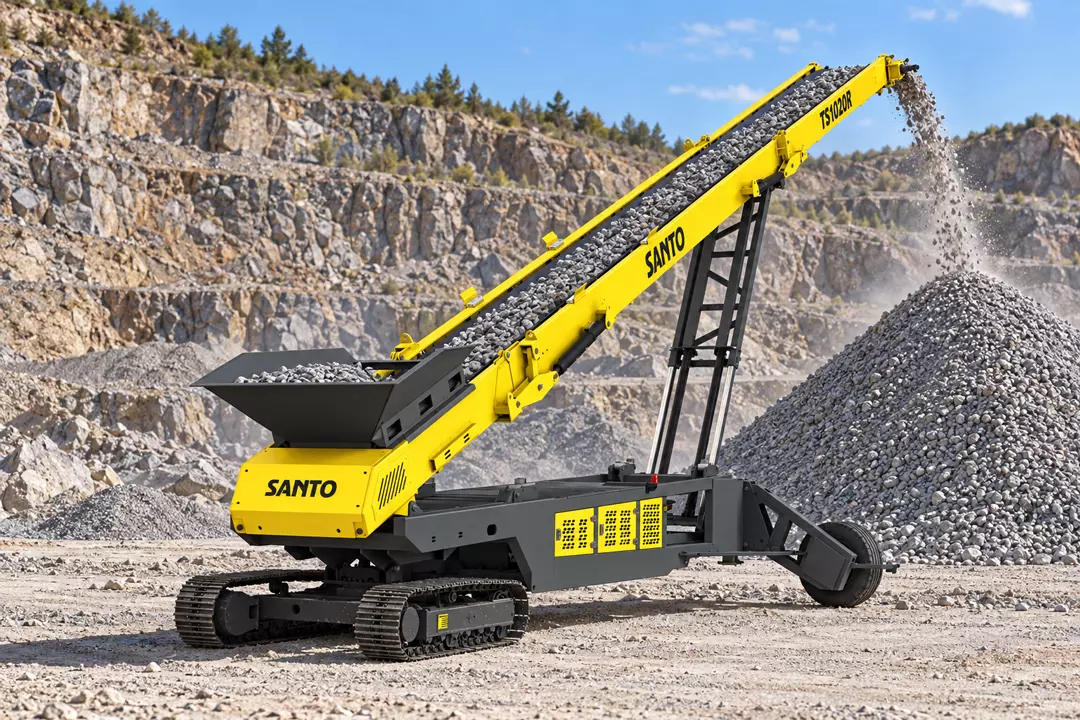
Move crushed stone, sand, gravel and mineral materials from your processing equipment to the stockpile with a SANTO aggregate conveyor. Our mobile conveyors connect handling stages, receive crusher and screen discharge, and build stockpiles around your site layout.
Choose tracked mobility, radial stacking or telescopic reach to match the job. SANTO’s published tracked stockpiler tables include models with capacities of 300, 500 and 700 tonnes per hour, depending on the model. Start with your material, production rate and available space to identify a suitable configuration.
Aggregate Conveyor Systems for Your Production Flow
Effective aggregate conveyor systems connect the material source, transfer route and stockpile. Identify where material enters the system and where you need it to go before choosing individual machines.
Stockpiling After Crushing and Screening
Crusher or Screen Discharge → Mobile Stacker → Stockpile
A mobile stacker receives material from an existing crusher or screen and carries it to a stockpile. This arrangement can reduce the need to collect material beneath a discharge belt and move it again with a wheel loader.
Match the conveyor’s receiving height, belt width and capacity to the upstream equipment. Where a screen produces several aggregate grades, plan separate discharge routes and stockpile areas to keep those products apart.
Transferring Material Between Processing and Storage Areas
Existing Discharge Point → Transfer Conveyor(s) → Stockpiling Conveyor
Transfer conveyors bridge the distance between processing equipment and storage areas. A single conveyor may cover a short route; longer routes may need several units and carefully positioned transfer points.
Check horizontal distance, elevation changes and access routes together. Metso’s mobile conveyor documentation illustrates how operators connect individual conveyors to move material between processing stages in quarry and mining operations. 1
Loader-Fed Conveying and Stockpiling
Wheel Loader → Hopper Feeder → Conveyor or Stacker → Stockpile
A wheel loader supplies the hopper, and the feeder regulates material flow onto the conveyor. This arrangement suits operations that receive material in batches.
The loader still performs the initial feeding task. The conveyor can reduce subsequent carrying and pile-building work where the layout supports a direct route to storage.
Reduce Double Handling and Improve Stockpile Layout
A quarry conveyor delivers value when it removes an unnecessary handling step or helps the site manage material more effectively. Compare the proposed material route with your current operation.
Convey Material Directly to the Stockpile
Consider a process that drops aggregate onto the ground before a loader carries it to the storage area. A conveyor connection may remove that intermediate pickup and carrying stage.
For a simple planning example, assume a plant maintains 500 t/h for 8 operating hours:
500 t/h × 8 h = 4,000 tonnes
If a conveyor replaces one loader transfer per tonne on that route, it shifts 4,000 tonnes of transfer work from the loader to the conveyor during that period. This example does not predict fuel savings or actual shift output; stoppages, feeding conditions and remaining loader duties affect the result.
Use Radial Movement to Extend the Stacking Area
A radial stacker moves its discharge point through an arc and distributes material across a wider stacking area. Plan the operating radius alongside stockpile boundaries, access lanes and reclaim space.
Telestack identifies stockpiling, linking and handling different material grades as key quarry applications for mobile conveyors.
Adjust Reach as the Stockpile Develops
A telescopic stacker extends and retracts its conveyor section to change the discharge position. Operators can coordinate reach, radial position and elevation as the pile grows.
Stacking patterns also influence material distribution. Superior’s technical guidance explains how radial and telescopic movements support controlled pile-building sequences. The result depends on the equipment, operating method and material; telescopic movement alone does not guarantee uniform grading.
Choose SANTO Conveyors for Each Handling Task
Select equipment by its role in the material route. Check the receiving point, transfer connections and discharge position together.
Mobile Conveyors for Transfer and Stockpiling
The SANTO Tracked Stockpiler handles transfer and stockpiling tasks alongside crushers and screens. Its hydraulic adjustments help operators match the receiving position to upstream equipment.
The following examples come from SANTO’s published model tables:
| Model | Belt width | Conveyor length | Discharge height | Listed capacity |
|---|---|---|---|---|
| TS820 | 800 mm | 20 m | 8.6 m | 300 t/h |
| TS1024 | 1,000 mm | 24 m | 9.9 m | 500 t/h |
| TS1230 | 1,200 mm | 30 m | 13.4 m | 700 t/h |
Use these figures for initial comparison. Confirm the operating configuration and material conditions with SANTO before selecting a model. Discharge height does not directly specify usable stockpile height.
Consider the Wheeled Mobile Conveyor alongside tracked options when evaluating relocation methods and site access.
Radial Stackers for Wider Stockpile Coverage
The SANTO Tracked Radial Stockpiling Conveyor combines tracked relocation with radial stacking.
Choose this arrangement when the stockpile layout benefits from a moving discharge point. Check the available sweep area, ground conditions and surrounding equipment before defining the working position.
Telescopic Stackers for Adjustable Reach
The SANTO Radial Telescopic Stockpiler combines telescopic reach, elevation adjustment and radial movement.
Consider it when the application requires several discharge positions within a planned stockpile area. Define the required footprint and reclaim access before choosing the conveyor length.
Hopper Feeders for Controlled Material Supply
The SANTO Feeder Track Stacker accepts material from loaders or excavators and regulates output to downstream equipment.
SANTO lists the FTS1015 with a 1,000 mm belt, 15 m length and 500 t/h capacity. The FTS1215 uses a 1,200 mm belt over the same 15 m length, with a listed capacity of 700 t/h.
Compare tracked and wheeled feeder options, including the Feeder Mobile Stacker, against your feeding method and relocation requirements.
Transfer Conveyors for Connecting Work Areas
The SANTO Grasshopper Conveyor connects equipment and operating areas. SANTO describes conveyor lengths from 20 to 45 m, with adjustable discharge height for equipment interfaces.
Choose each unit around the actual transfer geometry. Adding conveyor lengths together does not establish usable horizontal reach: inclination and transfer overlap also affect the layout.
Materials and Site Conditions That Shape the Configuration
The material name provides a starting point. Density, particle size and moisture determine how the conveyor must handle it.
| Material or application | Main configuration questions |
|---|---|
| Crushed stone and limestone | What maximum lump size, abrasion and receiving impact must the equipment handle? |
| Sand and gravel | How do moisture and fines affect flow, carryback and cleaning? |
| Road base and graded aggregates | How will the operation keep grades separate and manage pile building? |
| Ores in surface mining | How do bulk density and particle size affect loading and transfer requirements? |
Mass flow and volume flow describe different requirements. For example, assume a material has a bulk density of 1.6 t/m³:
500 t/h ÷ 1.6 t/m³ = 312.5 m³/h
This calculation converts mass flow to volume flow; it does not size the belt. Engineers also assess belt speed, material cross-section, inclination and loading conditions. Manufacturer specifications commonly qualify throughput by material and bulk density, as MDS does for its tracked conveyors.
For a mining conveyor application, provide actual ore data rather than reusing an aggregate specification.
Specify a Quarry Conveyor Around Your Site
Prepare these 8 project inputs to support equipment selection:
| Project input | What to provide |
|---|---|
| 1. Material and particle size | Material name, grading and maximum lump size in mm |
| 2. Density and moisture | Bulk density in t/m³ and moisture content in % |
| 3. Required throughput | Normal and peak flow in t/h |
| 4. Equipment interfaces | Existing crusher or screen model, discharge dimensions and heights in m |
| 5. Transfer route | Horizontal distance, elevation changes and available corridor |
| 6. Stockpile requirements | Available footprint in m², target volume in m³ and reclaim method |
| 7. Ground and mobility | Surface condition, slopes, access restrictions and relocation frequency |
| 8. Power and maintenance | Available supply, operating hours and service access |
Include a site sketch that marks feed points, conveyors, stockpiles and vehicle routes. Give each transfer point particular attention: check material impact, spillage, dust and access for cleaning.
NIOSH recommends minimizing unnecessary fall height and avoiding abrupt changes in material direction when designing transfer points. Discuss suitable chute geometry and dust controls during engineering rather than treating them as later additions.
Aggregate Conveyor FAQs
What does an aggregate conveyor do in a quarry?
An aggregate conveyor can receive crusher or screen discharge, transfer material across the site, or feed a stockpile.
Can a mobile conveyor work with an existing crusher or screen?
Yes, when the equipment interfaces and operating requirements match. Provide the upstream machine’s model, discharge height, material size and throughput. SANTO can then assess the receiving position and conveyor configuration.
How can conveyors reduce double handling?
A conveyor can move material directly from a discharge point to the intended stockpile, removing an intermediate loader pickup and carrying stage.
When should I consider a radial or telescopic stacker?
Consider radial movement when you need a wider stacking arc. Consider telescopic reach when you need to adjust the discharge distance within the stockpile area.
Discuss Your Aggregate Handling Project
Share your material data, required throughput and existing plant layout with SANTO. Include the transfer distance, feed height and stockpile requirements so we can discuss suitable equipment combinations.
Send your:
- Material type and maximum particle size
- Required capacity in t/h
- Existing crusher or screen details
- Transfer distance and elevation change
- Stockpile footprint and target volume
- Site location and available power
Contact SANTO to discuss your application and request a conveyor proposal.
External References