
In the storage and handling of industrial bulk materials, the efficiency and safety of stockpiling operations directly affect a company’s production rhythm and warehousing costs.
With the advancement of modern logistics and bulk material handling systems, mobile conveyors — known for their flexibility and efficiency — are gradually replacing traditional fixed conveyors, becoming essential equipment in stockpiling systems across industries such as mining, power plants, ports, and construction materials.
Structure and Features of Mobile Conveyors
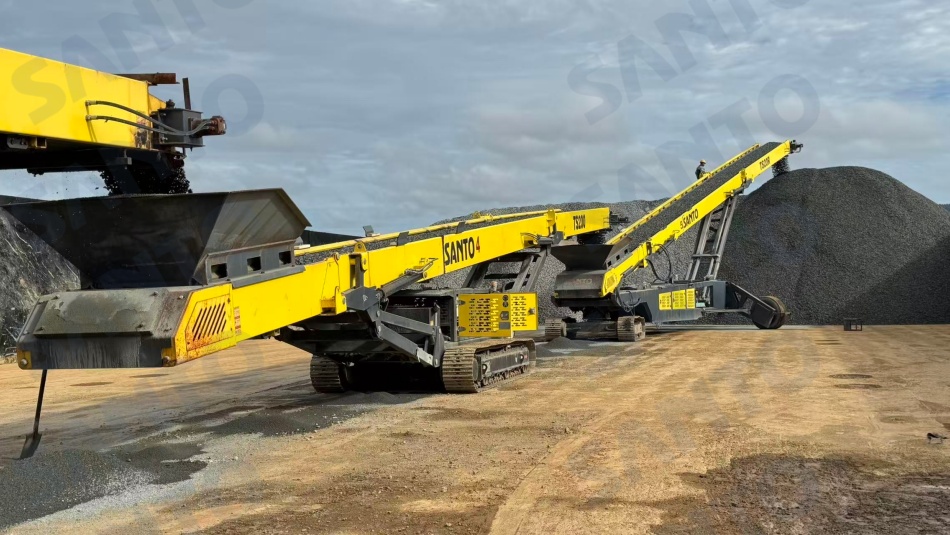
A mobile conveyor is a type of material conveying equipment that can be flexibly moved. It generally consists of a belt conveyor, drive unit, traveling mechanism, lifting system, and electrical control system.
Depending on the application scenario, mobile conveyors can be designed in various configurations such as wheel-mounted, tracked, telescopic, or foldable types.
Compared with traditional fixed conveyors, mobile conveyors have the following notable advantages:
Flexible mobility: The equipment can be freely moved to different stockpiling points without the need for civil foundations, suitable for multiple work sites.
Adjustable stockpiling height: Hydraulic or electric lifting mechanisms allow for different conveying angles and stacking heights.
Time and labor saving: High automation reduces manual loading and rehandling operations.
Low investment cost: No complex infrastructure is required, ensuring quick deployment and easy relocation or modification.
Application Scenarios of Mobile Conveyors in Stockpiling
Mobile conveyors are widely used in various bulk material storage and transfer fields, including:
Ore and coal stockyards: Continuously stack ores or coal into conical piles in open yards, facilitating subsequent loading and reclaiming.
Cement and aggregate production lines: Used for temporary storage and stockpiling of aggregates, improving space utilization.
Port and terminal operations: Can be used with grab buckets or bucket wheel machines for bulk cargo loading, unloading, and transfer.
Chemical and grain industries: Suitable for temporary storage and separation of granular or powder materials, preventing cross-contamination.
Advantages of Mobile Conveyors in Stockpiling Operation
High stacking capacity and neat pile shape
By adjusting the conveying angle, the system achieves continuous and uniform stacking. The maximum stacking height can exceed 10 meters, significantly improving yard utilization.
Reduced handling and improved efficiency
Materials can be stockpiled directly from the production line without intermediate transfers, increasing overall operational efficiency by more than 30%.
Lower dust and energy consumption
Compared with wheel loader operations, mobile conveyors enable enclosed or semi-enclosed conveying, effectively reducing dust emissions and fuel consumption.
Flexible configuration and strong adaptability
Can be custom-designed according to yard size, material characteristics, and working conditions — such as adding telescopic sections, slewing devices, or automatic travel systems.
SANTO Mobile Conveyors
With their flexibility, efficiency, environmental performance, and low operating cost, mobile conveyors have become an integral part of modern stockpiling systems.
SANTO is a professional manufacturer specializing in mobile conveyors. Over the past twenty years, we have focused on the research and development as well as manufacturing of mobile conveyor systems.
Thanks to outstanding quality and reliable performance, our products have been successfully exported to more than 60 countries and regions, widely applied in industries including mining, ports, logistics, construction, and agriculture — earning high recognition and praise from our global customers.